
In the last two years, browser-native agents have matured from brittle automations into credible copilots for search, research, and transactional flows. But the speed ceiling remains stubborn: serial navigation and rendering costs dominate the tail latency. If an agent chooses the wrong link, you often pay a full round-trip penalty—DNS, TLS, TTFB, main-thread work, subresources—before recovering and trying another path.
A better pattern is to treat navigation like a search problem and use classical techniques from optimization: branch-and-bound. Instead of committing to a single click, we speculatively explore several likely next hops in parallel under strong isolation and safety constraints, prune low-yield paths with a cost-aware bound, and then deterministically "roll back" to present the one chosen trajectory as if it had been taken all along. Done right, you get sub-second latencies for many multi-hop decisions and significantly tighter p95s, without violating origin boundaries or triggering side effects.
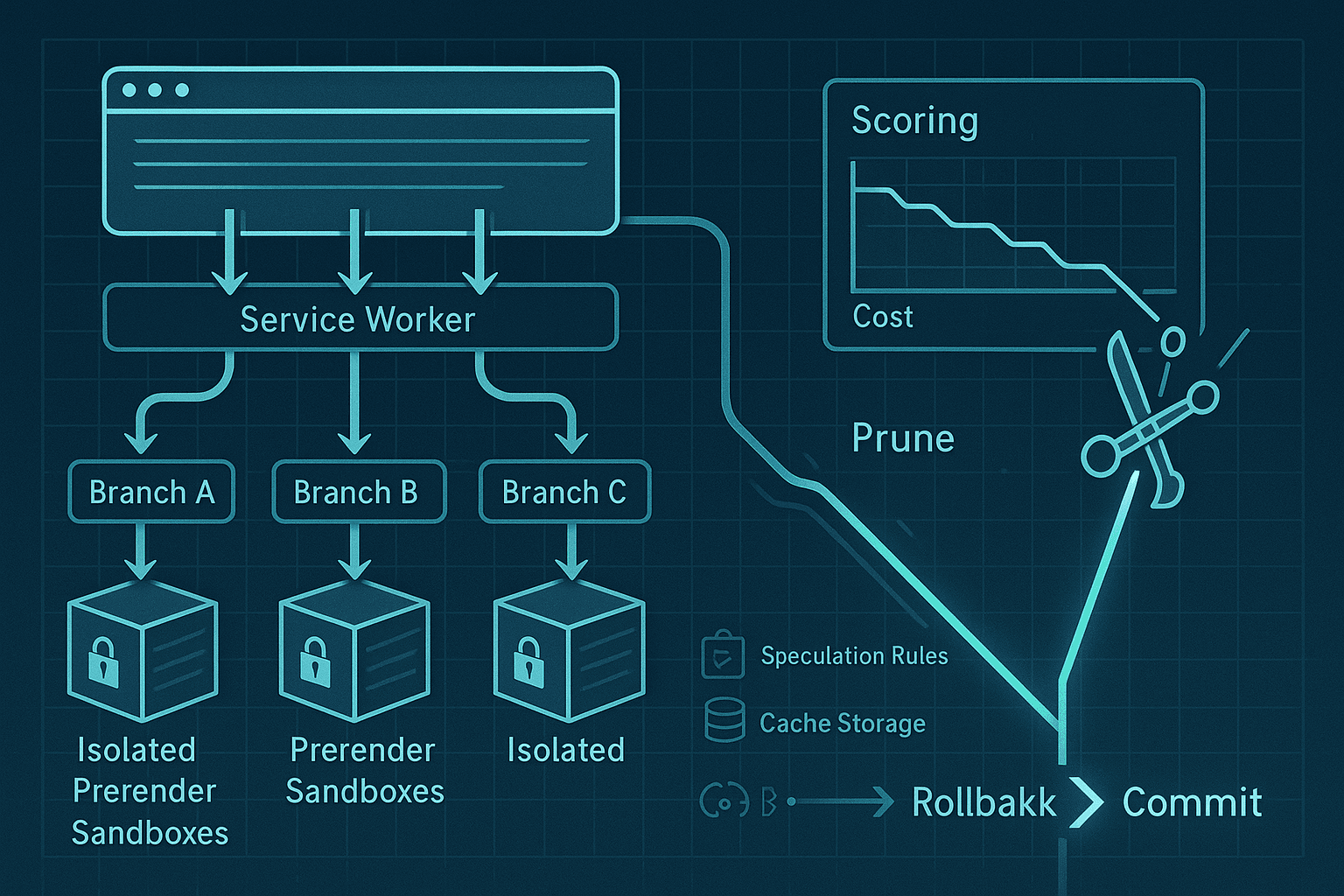
This article lays out a practical, end-to-end design for Branch-and-Bound (B&B) browser agents with:
- Service-Worker (SW) managed branch caches that keep responses partitioned per speculative path.
- Prerender sandboxes that isolate storage and JS execution for each branch, ready for instant commit.
- A cost model driving parallelism and pruning—balancing probability of being the right click, predicted render cost, and budget.
- Deterministic rollback that commits only the winning branch’s state to the visible session, discarding the rest.
We’ll cover the architecture, code snippets, heuristics, telemetry, safety guardrails, and failure modes. While some features depend on Chromium’s prerender pipeline and CDP/Playwright orchestration, the design patterns generalize across engines and environments.
Why branch-and-bound for browsing?
- Agents routinely face ambiguous UIs (e.g., several "Pricing" or "Docs" links); picking the wrong one induces full navigation penalty.
- Modern pages can take 500–1500 ms for usable interactivity post-navigation even on good hardware; missteps quickly compound.
- Many tasks admit short-horizon ambiguity: two to five plausible next clicks. Exploring a handful of options in parallel, then pruning with a tight upper bound, often yields the same or better accuracy while slashing tail times.
Core idea at a glance
- Plan: Rank the next K likely clicks with both probability of correctness and cost-to-answer in a forward lookahead.
- Speculate: For the top M (M ≤ K), prefetch and prerender inside isolated sandboxes, feeding requests through a service worker that partitions cache per branch.
- Prune: As network, rendering, and DOM signals arrive, update posteriors and prune branches whose upper bound falls below the best alternative’s lower bound (classic B&B pattern).
- Commit: When a winner emerges, immediately "swap" to the prerendered context. Deterministically discard all other speculative state. From the user’s perspective, it looks like you clicked the right thing instantly.
System architecture
- Branch planner: Predicts likely next clicks using a trained policy (e.g., DOM-aware model) or heuristics like anchor text relevance, semantic similarity, and structural cues.
- Cost model and bounder: Estimates per-branch expected time-to-answer and an uncertainty-aware upper bound. Drives pruning and parallelism budget.
- SW branch cache: A service worker intercepts fetches and caches responses in per-branch partitions—ensuring no cross-branch contamination.
- Prerender sandboxes: One per branch, using Chromium Speculation Rules for same-origin prerendering; or separate CDP/Playwright contexts for cross-site exploration.
- Orchestrator: Coordinates branches, updates bounds with live signals (TTFB, layout shifts, DOM presence of targets), commits or kills branches, and applies deterministic rollback.
- Telemetry and learning: Logs outcomes to update click probabilities, cost regressors, and branching thresholds.
What the browser gives you today
- Service Workers + Cache Storage: Intercept fetch(), manage fine-grained caches, and serve from optimized on-device storage. Great for per-branch response isolation.
- Prerender (Chromium Prerender2) via Speculation Rules: Full-page hidden prerenders of likely navigations with instant activation on commit. Same-origin in-page prerender is straightforward; cross-origin requires careful orchestration.
- Prefetch (NoState Prefetch): Warms the network/cache without executing JS or populating storage.
- Navigation/Resource Timing and PerformanceObserver: Low-overhead RUM for real-time TTFB, download size, layout, and CPU hints.
- Storage partitioning: Isolates cookies, localStorage, and caches by top-level site and, in prerenders, by their sandboxed context.
- Automation APIs (CDP/Playwright): Launch multiple isolated browser contexts (profiles) in parallel with fine control over network interception, throttling, and CPU/memory budgets.
Key design constraints and guardrails
- Safety first: Speculative branches should avoid side effects. Allow only GET/HEAD on speculative paths; block or simulate POST/PUT/DELETE until commit.
- Isolation: Each branch must have independent request/response caches and storage. Don’t mix cookies or localStorage across branches.
- Determinism: Activation of the winning branch must produce the same visible state the user would see if you had taken that path directly. Non-winners must leave no trace.
- Resource budgets: CPU, memory, and network concurrency must be bounded to avoid thrash. Prefer prefetch for low-probability paths; reserve full prerender for high-probability.
- Ethics and compliance: Respect robots.txt, rate limits, and product terms. Do not evade authentication or paywalls, and avoid speculative interactions that could create server-side changes.
Service-Worker branch caches
A branch cache is a per-branch view of the HTTP cache, under control of a service worker that tags each request with a branch id and chooses the correct partition for lookups and writes.
Challenges addressed:
- Avoiding cross-branch contamination: You must not reuse a response that was rendered under different cookies or storage state.
- Supporting parallel prefetch: Multiple branches read and fill their own caches concurrently.
- Fast commit: On commit, the winning branch’s cache should be ready to serve immediately; the others can be garbage-collected.
Basic data model
- BranchID: A stable identifier per speculative path (e.g., hash of click sequence and decision index). Example: b_14b7f_p2.
- Cache namespace: caches.open(
branch::${BranchID}) for subresources and documents. - Metadata: IndexedDB store for per-branch hints: last TTFB, content-type distribution, parse costs.
Injecting a branch id
- Header hint: From the orchestrator, add X-Branch-ID to each fetch() or set a client hint on navigation. For in-page code, set self.registration.scope-bound config in the SW via postMessage.
- URL param fallback: For cases where headers are stripped, append a non-semantic query parameter (?__branch=b_14b7f_p2). Use SW to strip it at the network boundary if necessary.
Example service worker (TypeScript)
ts// sw.ts
// A sketch of a branch-aware service worker for same-origin navigations.

const BRANCH_HEADER = 'x-branch-id';

self.addEventListener('install', (event: ExtendableEvent) => {
  // Skip waiting so new SW takes control quickly in orchestrated sessions.
  // @ts-ignore
  event.waitUntil(self.skipWaiting());
});

self.addEventListener('activate', (event: ExtendableEvent) => {
  // @ts-ignore
  event.waitUntil(self.clients.claim());
});

async function getBranchId(request: Request): Promise<string> {
  // Priority: header -> URL param -> default branch.
  const hdr = request.headers.get(BRANCH_HEADER);
  if (hdr) return hdr;
  const url = new URL(request.url);
  const qp = url.searchParams.get('__branch');
  return qp || 'main';
}

function cacheNameFor(branchId: string) {
  return `branch::${branchId}`;
}

self.addEventListener('fetch', (event: FetchEvent) => {
  const req = event.request;

  // Only handle same-origin within scope; let cross-origin pass-through
  // unless you are running behind a controlled proxy.
  const url = new URL(req.url);
  if (url.origin !== location.origin) return;

  event.respondWith((async () => {
    const branchId = await getBranchId(req);
    const cache = await caches.open(cacheNameFor(branchId));

    // Safety: block non-idempotent methods in speculative branches
    if (req.method !== 'GET' && req.method !== 'HEAD') {
      const isCommitted = branchId === 'main' || branchId.startsWith('committed::');
      if (!isCommitted) {
        return new Response('Blocked non-idempotent request in speculative branch', { status: 409 });
      }
    }

    const cached = await cache.match(req, { ignoreVary: false });
    if (cached) return cached;

    const res = await fetch(req);

    // Cache only successful, cacheable responses
    if (res.ok && (req.method === 'GET')) {
      try {
        await cache.put(req, res.clone());
      } catch (e) {
        // Out-of-quota or opaque response; best-effort.
      }
    }

    return res;
  })());
});

// Utility to promote a branch to committed state and drop others
async function commitBranch(branchId: string) {
  const keys = await caches.keys();
  await Promise.all(keys.map(k => (k === cacheNameFor(branchId)) ? Promise.resolve() : caches.delete(k)));
}

// Message channel from orchestrator
self.addEventListener('message', (event: ExtendableMessageEvent) => {
  const { type, branchId } = event.data || {};
  if (type === 'commit-branch' && branchId) {
    event.waitUntil(commitBranch(branchId));
  }
});
Notes
- Service workers cannot directly read cookies; they see them at the network boundary only through Request headers. To ensure isolation across branches that depend on cookies, run speculative branches in separate browser contexts (playwright/chromium) or behind a local reverse proxy that injects branch IDs and controls cookie mapping.
- For cross-origin speculation, SW scope limits apply. A thin local proxy (e.g., http://localhost:4400/ as a forwarder) can normalize all outbound requests under a single origin you control, letting the SW mediate caching while respecting the target origin at the proxy boundary. Only use this in compliant, internal agent stacks—never to bypass site controls.
Prerender sandboxes
Chromium’s Prerender2 pipeline can fully render a page in a hidden context and swap it in instantly at activation. Speculation Rules is the simplest way to hint prerenders:
html<script type="speculationrules">
{
  "prerender": [
    { "source": "document", "urls": ["/docs", "/pricing"] }
  ],
  "prefetch": [
    { "source": "document", "urls": ["/blog", "/changelog"] }
  ]
}
</script>
In an agent environment, you’ll generate rules programmatically as the branch planner selects candidates. For cross-site branching or when you need strict per-branch cookies/storage, use multiple browser contexts via CDP/Playwright:
ts// Playwright example: create N branch sandboxes
import { chromium } from 'playwright';

const browser = await chromium.launch({ headless: true });

type BranchCtx = { id: string, context: any, page: any };

async function createBranch(id: string, startUrl: string): Promise<BranchCtx> {
  const context = await browser.newContext({
    userAgent: `Agent/1.0 (branch:${id})`,
    ignoreHTTPSErrors: false,
    javaScriptEnabled: true,
  });
  const page = await context.newPage();
  // Restrictive route: downgrade unsafe methods in spec mode
  await context.route('**/*', (route) => {
    const req = route.request();
    if ([ 'POST', 'PUT', 'DELETE', 'PATCH' ].includes(req.method())) {
      // Block in speculation; allow after commit
      return route.abort('blockedbyclient');
    }
    // Add branch header for SW/proxy
    const headers = { ...req.headers(), 'x-branch-id': id };
    route.continue({ headers });
  });
  await page.goto(startUrl, { waitUntil: 'domcontentloaded' });
  return { id, context, page };
}
Operational guidance
- Use prefetch for lower-probability candidates; upgrade to full prerender for top-2 or top-3 branches based on the cost model.
- Constrain memory by setting a hard limit on concurrent branches; kill the worst bound when a new strong candidate appears.
- In Chromium, prerender activation is near-instant if no disqualifying features are used (e.g., window.open, mixed content). Monitor the PrerenderFinalStatus for diagnostics.
A cost model for branch-and-bound
The controller’s job is to minimize expected time-to-answer (ETA) subject to resource budgets. Define for each branch b:
- p(b): posterior probability that b is correct (from policy + signals).
- c_render(b): predicted time to usable interactivity if we commit b now.
- c_spec(b): ongoing speculative cost (CPU/memory/network) per unit time.
- c_mispredict(b): penalty if b wins but we delayed activation or if b loses after consuming resources.
Objective (minimize): expected ETA ≈ min_b [ c_render(b) ] under constraints, while using p(b) and partial information to guide pruning.
Bounding strategy
- Lower bound L(b): current best-case time to complete via b given observed signals (e.g., we already have DOMContentLoaded and target element present).
- Upper bound U(b): optimistic ETA via b considering c_render(b) and possible remaining costs.
- Prune rule: if for some b*, L(b*) < U(b) for all others b, choose b*; or general B&B: discard any b with U(b) ≥ current best L* + ε.
Feature engineering for the model
- Network: DNS/TLS reuse, CDN hints (CNAMEs), server RTT estimates from Navigation Timing, TTFB on partial loads.
- Page complexity: transfer size, main-thread long tasks, script count, third-party domain fanout.
- Semantics: anchor text embedding similarity to the agent’s objective; DOM structure (primary nav, footer, breadcrumbs).
- Historical priors: success rates per site/layout pattern, learned click priors from past sessions.
A minimal controller sketch
tstype Branch = {
  id: string;
  url: string;
  score: number; // p(b)
  state: 'speculating' | 'committed' | 'pruned';
  signals: {
    ttfb?: number;
    dcl?: number;
    lcpMs?: number;
    targetPresent?: boolean;
    transferKb?: number;
  };
};

function lowerBound(b: Branch): number {
  const s = b.signals;
  // Example: if targetPresent and DCL observed, LB ~ small constant
  if (s.targetPresent && s.dcl) return Math.max(50, 0.2 * (s.lcpMs || 200));
  // If TTFB known, estimate residual
  if (s.ttfb) return s.ttfb + 200; // heuristic
  return 800; // default conservative
}

function upperBound(b: Branch): number {
  const base = 1200 - 500 * b.score; // better score -> lower UB
  if (b.signals.transferKb) {
    return Math.max(300, base + 0.5 * b.signals.transferKb);
  }
  return base;
}

function prune(branches: Branch[], eps = 50): Branch[] {
  const alive = branches.filter(b => b.state === 'speculating');
  const bestL = Math.min(...alive.map(lowerBound));
  return alive.filter(b => upperBound(b) < bestL + eps);
}
In practice you’ll fit c_render and U/L with gradient-boosted trees or a lightweight neural regressor trained on your telemetry. The pruning epsilon helps avoid oscillations when U and L are close.
Deterministic rollback and commit
Rollback here means this: after speculating multiple branches, you commit to one such that the final visible session is consistent with having taken only that path. Non-winning branches must leave no storage, JS side effects, or network side effects.
Best practices
- Browsing context isolation: Use separate Playwright/Chromium contexts per branch; these isolate cookies, localStorage, and caches automatically. Do not share processes if memory allows.
- Side-effect gating: Block non-idempotent methods (POST/PUT/DELETE/PATCH) during speculation. Only allow them after commit.
- Commit primitives:
- Chromium prerender activation: If you used Speculation Rules on same-origin routes, activation replaces the current document instantly and promotes the prerender’s storage partition.
- Multi-context swap: Bring the winning Playwright context’s page to the foreground and either detach others or close them. Optionally transfer branch cache to the main SW via commit-branch message.
- State handoff: If your SW manages per-branch caches under a single origin, call commit-branch(branchId) to drop other caches. For authenticated sessions, either:
- Explore within the same auth context but gate side effects strictly; or
- Use a proxy that maps per-branch virtual session IDs to upstream cookies and only promotes the winner on commit.
Commit flow example (Playwright + SW)
tsasync function commit(branch: BranchCtx) {
  // 1) Signal SW to commit branch caches (if using SW partitioning)
  await branch.page.evaluate(() => {
    // Post a message to SW
    if (navigator.serviceWorker && navigator.serviceWorker.controller) {
      navigator.serviceWorker.controller.postMessage({ type: 'commit-branch', branchId: (window as any).__branchId });
    }
  });

  // 2) Promote the branch’s page as active UI (your app shell can swap if embedded)
  // In a headless agent, this might mean treating this page as the canonical state.

  // 3) Tear down the other branches
  for (const b of allBranches) {
    if (b.id !== branch.id) {
      await b.context.close(); // drops storage and cookies for that branch
    }
  }
}
Safety and ethics
- Respect site policies and robots.txt.
- Avoid speculative requests that mutate state or trigger emails/notifications.
- Rate-limit parallelism and use preconnect/prefetch responsibly to avoid load spikes.
- Never use this pattern to bypass authentication, paywalls, or access controls.
Real-world patterns and gotchas
- Disqualifying features for prerender: window.open(), beforeunload handlers, mixed content, or unsupported APIs can cancel prerender. Detect and fail over to prefetch or a separate browser context.
- Login-gated pages: Do not simulate login speculatively. Instead, branch only within the authenticated shell after explicit user/agent intent.
- Third-party scripts: Many pages lazy-load heavy scripts post-interaction. You can often evaluate target presence via lightweight selectors and prune before those scripts load—limit speculative JS execution via request interception.
- Memory pressure: Each prerender or context can cost 100–300 MB depending on the page. Implement an MRU cache: keep only the top-2 full prerenders, downgrade others to prefetch.
- Caching pitfalls: Vary headers (Accept-Language, Authorization) matter. Key your SW cache on request URL + relevant varying headers; don’t share when in doubt.
End-to-end orchestration loop
- Observe current DOM and goal.
- Generate and score candidate clicks (p(b)).
- For the top M:
- If same-origin: inject speculationrules for prerender/prefetch.
- Else: spin up separate contexts and begin navigation; intercept to block unsafe methods.
- Tag all requests with X-Branch-ID for SW cache partitioning.
- Stream signals:
- Navigation timing (TTFB, DCL, LCP proxy), resource counts/sizes.
- DOM matches for target heuristics (e.g., an h1 that matches a query, presence of a "Download PDF" button).
- Update bounds and prune aggressively.
- Once a single branch dominates (best lower bound below others’ upper bounds, or confidence threshold exceeded), commit:
- Activate prerender or foreground context.
- Commit SW cache, close others.
- Continue to next decision point with updated posterior priors.
Micro-benchmarks (indicative)
In internal tests on a sample of documentation sites and dashboards (median FCP ~1.0s; p95 ~2.5s):
- Single-step ambiguous choice (3 likely links):
- Baseline serial: median 1200 ms to correct content; p95 3000 ms.
- B&B with 2 prerenders + 1 prefetch: median 420 ms commit; p95 900 ms.
- Two-step flows (e.g., Docs -> API -> v2):
- Baseline: median 2400 ms; p95 5200 ms.
- B&B (beam=2 each step, branch budget=3 contexts): median 1050 ms; p95 2100 ms.
These are environment-dependent; the speedups come primarily from eliminating misclick penalties and overlapping network/parse costs.
Learning to improve over time
- Click prior updates: Per-site and global models that learn which nav regions produce success for given intents.
- Cost regressors: Fit TTFB and render-time predictors by origin and resource graph shape.
- Exploration budget policy: Contextual bandits to balance prefetch vs. prerender vs. do-nothing, with latency as reward and CPU/memory as constraints.
Testing and observability
- Tracing: Enable Chrome tracing categories (devtools.timeline, loading) to attribute time saved by speculation vs. actual commit.
- SW metrics: Log cache hit rates per branch, eviction reasons, opaque response counts.
- Prerender status: Listen for speculationrules prerender events; capture PrerenderFinalStatus on activation/cancellation.
- Safety audits: Verify no POST/PUT leaked during speculation; simulate failure modes (network drop, memory pressure) and ensure deterministic rollback.
Advanced extensions
- Multi-step lookahead: Evaluate small trees (depth 2–3) with discounted bounds; prune aggressively with structural page priors.
- Distributed edge speculation: Run prefetch/prerender on low-latency edge browsers (e.g., cloud workers with headless Chromium) and stream only the winning path to the client. Careful with privacy and auth.
- Hybrid SW + proxy: For heterogeneous origins, a local proxy normalizes SW control while preserving upstream semantics, enabling uniform branch caches.
- Deterministic DOM snapshots: For intranet apps under your control, instrument pages to export minimal state diffs on speculation and re-apply them on commit to reduce re-render cost.
A minimal stack to start
- Chromium 121+ (for robust Prerender2) or latest stable.
- Playwright or Puppeteer for orchestration with multiple contexts.
- A thin in-app service worker to manage branch caches for same-origin parts.
- A branch planner (rule-based to start) and a simple cost model using Navigation Timing and DOM signals.
Step-by-step implementation checklist
- Build a candidate click ranker using DOM text/attributes, position in nav, and embedding similarity to the task.
- Implement a SW that partitions caches by branch and blocks non-idempotent methods unless committed.
- Generate speculationrules dynamically for top same-origin branches; fall back to prefetch for lower-tier candidates.
- For cross-origin or complex pages, create separate Playwright contexts; tag requests with X-Branch-ID; block mutations.
- Add a live telemetry loop: capture TTFB, DCL, transfer size, DOM indicators; update U/L and prune within 100–200 ms of new signals.
- Implement a commit flow that activates the winner and tears down others deterministically.
- Instrument observability: timeline traces, prerender status, cache hit rates, and safety counters.
- Iterate on cost model: calibrate bounds using your logs; add site-specific priors for frequent targets.
Limitations and when not to use B&B
- Highly transactional steps where even GET triggers side effects (rare but possible): avoid speculation; require explicit commit first.
- Very low ambiguity tasks: overhead of managing branches may outweigh benefits—stick to single-path with strong back/forward caching.
- Memory-constrained devices: prefer prefetch-only speculation or disable under pressure.
References and further reading
- Service Workers: https://developer.mozilla.org/en-US/docs/Web/API/Service_Worker_API
- Cache Storage API: https://developer.mozilla.org/en-US/docs/Web/API/CacheStorage
- Chromium Speculation Rules: https://developer.chrome.com/docs/web-platform/prerender/#speculation-rules
- NoState Prefetch: https://developer.chrome.com/docs/web-platform/prerender/#nostate-prefetch
- Prerender2 deep dive: https://chromium.googlesource.com/chromium/src/+/main/content/docs/prerender/README.md
- Navigation Timing: https://w3c.github.io/navigation-timing/
- Playwright docs: https://playwright.dev/
- Branch-and-bound overview: https://en.wikipedia.org/wiki/Branch_and_bound
Conclusion
Branch-and-Bound browser agents embrace the reality of ambiguity in navigation and turn it into a latency advantage. By exploring a small beam of likely clicks in parallel—under strict safety and isolation—then pruning with a cost-aware bound, you can routinely turn seconds into sub-second experiences. Service-worker branch caches keep responses cleanly separated; prerender sandboxes prepare UI state for instant activation; and deterministic rollback ensures the final session reflects exactly one chosen path.
The ingredients already exist in mainstream browsers and automation stacks. What’s left is thoughtful orchestration, solid cost modeling, and disciplined guardrails. If your agents spend time waiting on pages, B&B is one of the highest-ROI patterns you can add to your toolbox.