
Speculative Execution for Browser Agents: Sidecar Tabs, DOM‑Diff Arbitration, and Safe Rollback
Browser automation is shifting from linear scripting to adaptive decision-making. Agents that can read, plan, and act on the web still struggle with interface ambiguity, latency, and non-deterministic DOMs. If you ask a single-threaded agent to try a sequence of clicks, wait for network responses, and backtrack if a branch fails, you incur huge latency and often corrupt the tab state along the way. Worse, you miss easy wins when multiple plausible next steps exist, but only one is correct.
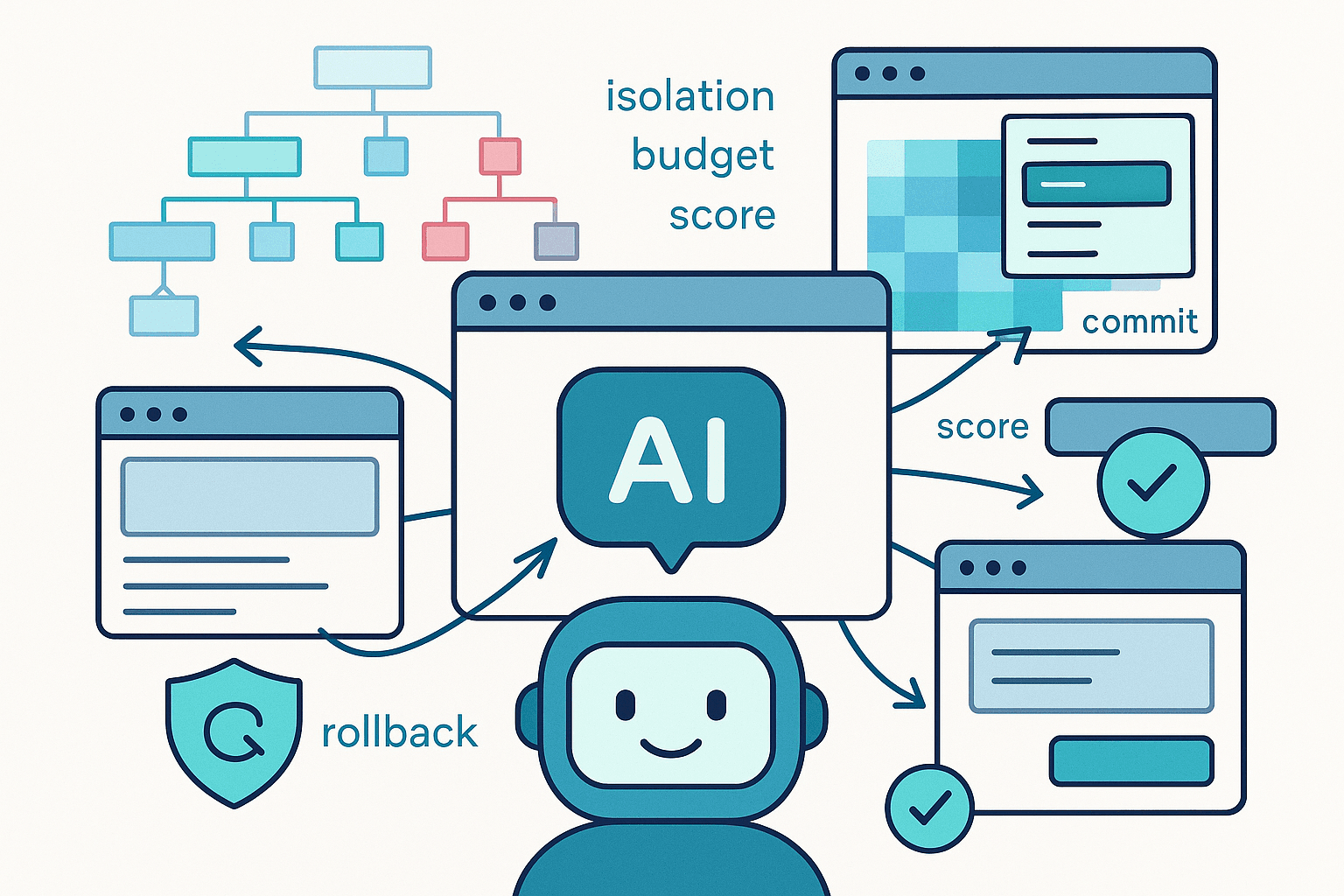
Speculative execution offers an elegant answer. Borrowing from CPU design and search-based planning, the idea is simple: when the next action is uncertain, branch. Spawn isolated sidecar tabs that explore competing actions in parallel, evaluate their outcomes by diffing DOM states, arbitrate a winner, and only then commit the action path to the main task. If nothing looks promising, rollback safely with zero side effects to the user-visible tab.
In this piece, I lay out a concrete architecture, practical isolation strategies, DOM-diff arbitration techniques robust to flaky layouts, budget scheduling, and training signals you can harvest from branch outcomes. The goal is not just speed; it is stability, reproducibility, and a cleaner gradient for training agents that survive real-world web diversity.
Why speculative execution for browser agents
- Latency hiding: Parallel branches mask network round-trips. Instead of waiting 2 seconds to learn that pressing Enter is wrong, you can simultaneously try clicking the search button, pressing Enter, or opening a result in a new tab.
- Robustness to UI ambiguity: When the interface presents multiple affordances (two login buttons, crowded menus, dynamic modules), speculation lets you explore without committing to a single brittle path.
- Reduced state corruption: By isolating exploration away from the main tab, you avoid contaminating cookies, local storage, or session history with dead-end steps.
- Better training signals: Branch outcomes yield counterfactual data (what would have happened) that can be turned into high-quality supervision and policy improvement without inflicting failures on the main trajectory.
The analogy to CPU branch prediction is helpful but imperfect. Unlike CPUs, browser agents explore high-latency, side-effectful environments with unpredictable UI and server state. The right model is closer to Monte Carlo Tree Search, with costly expansions and an outsized emphasis on safety and isolation.
System overview
A workable speculative execution stack for browser agents revolves around these components:
- Coordinator: Owns the main task state and prompts or policy. Decides when to branch.
- Branch manager: Spawns N isolated sidecar tabs (or contexts) per decision point. Encodes candidate actions per branch.
- Sidecar executor: Plays the branch actions inside an isolated browser context, captures DOM snapshots and telemetry, and enforces per-branch budgets.
- DOM snapshot and diff engine: Extracts canonicalized DOM features from each sidecar and computes diffs relative to the main tab and between branches.
- Arbiter: Scores branches, picks a winner, or chooses to abstain if none meet the threshold.
- Rollback manager: Guarantees that losing branches leave no trace. Applies the winning branch to the main tab, or no-ops.
- Safety and policy guard: Enforces domain allowlists, anti-purchase or anti-submit gating, and rate limits.
- Telemetry and training logger: Emits per-branch outcomes and diffs as training signals, including regret if the main path underperforms.
The architectural maxim: sidecars are cheap and disposable; the main tab is precious.
Isolation first: sidecar tabs and storage partitioning
A branch should never alter the main tab or its origin storage until it wins. There are several levels of isolation you can exploit:
- Separate browser contexts: Incognito or temporary contexts in Chrome/Chromium isolate cookies, localStorage, IndexedDB, cache, and service workers from the default context.
- Per-origin partitioning: Modern browsers support partitioned storage and CHIPS (Cookies Having Independent Partitioned State). Use this to limit spillover when branches navigate cross-origin or embed third-party frames.
- Network-level isolation: Stub or sandbox branch network requests, enforce domain allowlists, and mark sensitive HTTP methods (POST to checkout) as blocked or require human approval.
- Script-level fences: Inject scripts that intercept window.open, pushState, replaceState, and form submits, and that tag DOM mutations to facilitate canonicalization and diffing.
In Playwright, for example, you can spawn ephemeral contexts safely:
tsimport { chromium } from 'playwright';

async function newIsolatedContext(browser) {
  const context = await browser.newContext({
    storageState: undefined,   // no shared cookies
    permissions: [],           // explicit permissions only
    bypassCSP: false,
    userAgent: 'AgentSidecar/1.0',
    viewport: { width: 1280, height: 800 },
    javaScriptEnabled: true,
    ignoreHTTPSErrors: false,
  });

  // Disable cache and block dangerous requests
  await context.route('**/*', route => {
    const req = route.request();
    const method = req.method();
    const url = req.url();

    // Block known sensitive endpoints or methods by default
    const blocked = method === 'POST' && /checkout|purchase|delete|transfer/i.test(url);
    if (blocked) return route.abort('blockedbyclient');

    return route.continue();
  });

  return context;
}
With the Chrome DevTools Protocol (CDP), you can go deeper. Create a BrowserContext per branch and turn on per-context network, cache, and service worker policies. CDP also exposes DOMSnapshot and Performance APIs for efficient capture:
js// Pseudocode using CDP
const { sessionId } = await cdp.send('Target.createBrowserContext', { disposeOnDetach: true });
const { targetId } = await cdp.send('Target.createTarget', {
  url: 'about:blank',
  browserContextId: sessionId
});
const client = await attachToTarget(targetId);

await client.send('Network.enable');
await client.send('Network.setCacheDisabled', { cacheDisabled: true });
await client.send('ServiceWorker.disable');
await client.send('Page.enable');
await client.send('Runtime.enable');
Key point: minimize any shared global state. Do not reuse tabs or contexts between branches. If an optimization reuses anything, assume it can leak state and prove otherwise.
Branch generation: what to speculate and when
Speculation is not free. You need a strategy that decides when to branch and which candidates to try. Three pragmatic patterns:
- Action ambiguity: When the model yields multiple high-probability next actions that are mutually exclusive (e.g., click the magnifying glass vs press Enter), spawn branches for the top-k.
- Delayed reward: If the next outcome will take seconds to materialize, explore alternatives in parallel (e.g., multiple pagination controls or filter toggles).
- Escape hatch: If the agent is stuck in a low-information loop (elements not found, spinners cycling), branch into recovery strategies (refresh, open in new tab, broaden search, collapse overlays).
Candidate generation sources:
- Policy logits: Top-k from an action model or decoder distribution, temperature-controlled.
- Heuristic affordances: Link prominence, semantic labels, ARIA roles, and geometry (above-the-fold links get preference).
- MCTS/UCT: Lightweight Monte Carlo pivot where each branch is a simulation rollout of length 1–3 and bandit-style UCB scoring picks expansions.
- Value model: A learned critic predicts downstream reward (e.g., probability of seeing the target text or a form submit success) for each candidate.
Tie branching to explicit budgets so it does not spiral out of control.
Budgets: controlling cost and risk
Treat branching as consuming a budget vector: tabs, steps, time, and network.
- Tab budget: Max concurrent branches at any time. For laptops or shared servers, 3–5 sidecars is typically comfortable. Scale higher on headless clusters.
- Step budget: Max actions per branch, usually 1–3 until a clear reward is observed.
- Time budget: Strict wall-clock limit (e.g., 2 seconds per branch) to avoid tail latency from slow servers.
- Network budget: Cap total bytes or requests per branch to avoid DDoS-like behavior and triggering anti-bot defenses.
A good scheduler uses multi-armed bandit logic to allocate more budget to heuristics that historically win on similar domains. UCB1 or Thompson sampling can allocate an extra branch to a candidate generator with higher empirical win rate while preserving exploration.
DOM snapshotting that survives flakiness
Naive DOM diffs are fragile. Comparing outerHTML will flag noise from random IDs, timestamps, ads, A/B experiments, or live counters. You need a canonicalized snapshot that emphasizes semantically relevant structure.
Practical guidelines:
- Canonicalize: Strip dynamic attributes (data-reactroot, aria-describedby with generated IDs, nonce, anti-tracking query params). Normalize whitespace and collapse dynamic counters.
- Focused features: Hash subtrees (tag name, role, text signature, link destinations), count and positions of interactive elements, and the presence of key semantic cues (headings, form field labels, CTA text).
- Text signatures: Use minhash or character n-gram signatures of visible text rather than raw innerText to resist minor layout or punctuation changes.
- Viewport scoping: Prefer elements in the viewport or above-the-fold to reduce noise and emphasize what a human would see after the action.
- Layout fingerprints: Capture a coarse layout grid or bounding boxes of interactive elements to detect significant reflows vs minor shifts.
You can roll your own or lean on CDP's DOMSnapshot domain, which returns layout and text content in a compact structure:
js// Using CDP DOMSnapshot
const res = await client.send('DOMSnapshot.captureSnapshot', {
  computedStyles: [],
  includeDOMRects: true,
  includePaintOrder: false
});

// Convert to a canonical feature vector per node
function canonicalize(snapshot) {
  // Pseudocode: fold raw snapshot into stable features
  return snapshot.documents.map(doc => {
    // produce a bag of features: tags, roles, link texts, button labels, form fields
    return extractFeatures(doc);
  });
}
For pure JS environments, a lightweight in-page snapshotter works well:
jsfunction textSignature(node) {
  const t = (node.innerText || '').trim().toLowerCase().replace(/\s+/g, ' ');
  // simple n-gram hash to tolerate minor variations
  let h = 0;
  for (let i = 0; i < t.length; i++) h = (h * 31 + t.charCodeAt(i)) >>> 0;
  return h;
}

function featureOf(el) {
  const role = el.getAttribute('role') || '';
  const href = el.getAttribute('href') || '';
  const type = el.getAttribute('type') || '';
  const tag = el.tagName.toLowerCase();
  return {
    tag, role, type,
    textSig: textSignature(el),
    bbox: el.getBoundingClientRect().toJSON ? el.getBoundingClientRect().toJSON() : null
  };
}

function snapshotDOM(root = document) {
  const features = [];
  const walker = document.createTreeWalker(root, NodeFilter.SHOW_ELEMENT, null);
  while (walker.nextNode()) {
    const el = walker.currentNode;
    if (!el) continue;
    if (['script','style','noscript','meta','link'].includes(el.tagName.toLowerCase())) continue;
    const visible = el.offsetParent !== null || el === document.body;
    if (!visible) continue;
    const f = featureOf(el);
    features.push(f);
  }
  return {
    url: location.href,
    title: document.title,
    features
  };
}
To compare branches, compute a similarity score to the target condition and a delta from the main state. For example, a rank-boost if the target phrase appears, if a visible form becomes enabled, or if the number of results increased. Keep a small library of task-specific detectors: login form visible, pagination advanced, modal dismissed, download started.
Diff and arbitration: picking winners without overfitting
Arbitration needs to be both robust and multi-objective. Consider:
- Success signal: Direct detection of task completion or critical subgoal (e.g., URL matches expected pattern, button with text Submit is now disabled after click, confirmation toast present).
- Progress signal: The page clearly advanced toward the goal (new results, form error messages that indicate required fields, deeper navigation depth).
- Risk penalty: Potentially harmful state changes (cart item added, personal data revealed, suspicious redirects).
- Stability penalty: Flaky changes like ads or random feeds should not dominate.
A practical scoring function looks like:
score = w1 * success + w2 * progress - w3 * risk - w4 * instability
Where the weights can be domain-specific or learned. The arbiter then picks argmax score among branches, with abstain if all scores fall below a threshold or exhibit high risk.
If you already have a value model or a language model in the loop, you can also ask it to evaluate each branch with a compact structured prompt summarizing the diffs and key features:
- Before: main snapshot summary (top headings, visible CTAs, salient text signatures)
- After: branch snapshot summary
- Observations: e.g., new error message, content list length change, URL pattern change
- Ask: Does this represent progress toward the subgoal described in the instruction? Rate 0–1.
Keep it cheap: use distilled models, or batch prompts for all branches in one call with delimiters.
Safe rollback and commit strategies
Rollback is best when you never dirty the main tab. Two commit strategies work well:
- Sidecar-first: Always perform branch actions only in sidecars. When the arbiter picks a winner, re-enact the winning sequence in the main tab. Because you only execute 1–3 steps, replay usually aligns. If the page is highly dynamic, you can identify elements by robust selectors (role, text, relative geometry) rather than DOM index.
- Transactional guard: For actions with side effects (form submits, purchase), require a final confirmation gate. The sidecar verifies the expected confirmation screen. The main tab re-enacts the steps, and only at the confirmation screen does a human or hard-coded policy allow the final click. This is a UI-level two-phase commit.
For unavoidable mutations in the main tab (e.g., single sign-on flows requiring main tab origin state), use session snapshots:
- History snapshots: Use the navigation history API and take a screenshot + DOM snapshot before risky moves so you can detect and revert.
- Storage checkpoints: Export cookies and localStorage to a blob, attempt the action, and restore on failure. Playwright's storageState helps for cookies; localStorage/IndexedDB snapshots require custom scripts.
Example re-enactment with robust locator strategies in Playwright:
tsasync function replayActions(page, actions) {
  for (const a of actions) {
    switch (a.type) {
      case 'click': {
        if (a.selector) {
          await page.click(a.selector, { timeout: 2000 });
        } else {
          // Fallback: find by role and text
          await page.getByRole(a.role || 'button', { name: a.name, exact: false }).click({ timeout: 2000 });
        }
        break;
      }
      case 'type': {
        await page.fill(a.selector, a.text);
        break;
      }
      case 'press': {
        await page.keyboard.press(a.key);
        break;
      }
      default:
        throw new Error('Unknown action ' + a.type);
    }
  }
}
Rollback in sidecars is simple: close the context. If the main tab deviates unexpectedly during replay (element mismatch, differing DOM), abort and either attempt a fresh branch generation or fall back to human-in-the-loop.
Handling side effects beyond the DOM
Not all outcomes are visible in the DOM. Consider:
- File downloads: Intercept download events and capture metadata, but do not write to main filesystem without consent.
- Network mutations: Some APIs produce irreversible mutations (account changes, purchases). Use allowlists, dry-run modes if the site supports them, or mock credentials in sandboxes.
- Service workers and storage: Branch contexts should not register persistent service workers. Prefer contexts where service workers are disabled or auto-removed on disposal.
For CDP, disabling service workers per context is helpful. For Playwright, you can intercept routes and block registration scripts or wipe service workers on context close.
Putting it together: a branch lifecycle
- Detect ambiguity: Coordinator flags that multiple plausible next actions exist.
- Generate candidates: Branch manager prepares action sequences and allocates budgets.
- Spawn sidecars: Create N isolated contexts, navigate them to a synchronized baseline (URL and scroll position) from the main tab.
- Execute: Sidecar executor performs the candidate actions with strict timeouts and network guards.
- Snapshot: Capture canonicalized DOM and telemetry features.
- Score: Arbiter evaluates success, progress, risk, and stability; optionally queries a value model.
- Decide: Pick a winner or abstain.
- Commit: If a winner exists, replay on main tab; otherwise, take a recovery step or escalate.
- Cleanup: Dispose of sidecars and log outcomes for training.
Observability and reproducibility
Parallel exploration without good telemetry is chaos. Instrument every step:
- Structured traces: Use OpenTelemetry or similar to record spans for branch creation, navigation, actions, and scoring. Attach DOM fingerprints and network summaries as attributes.
- Snapshots: Save minimal snapshots per branch: URL, title, viewport screenshot, top-N features, and chosen actions. Avoid dumping full HTML with PII unless necessary and allowed.
- Determinism hints: Fix user agent, viewport, locale, timezone, and language; disable notifications and geolocation to reduce random prompts.
- Replay logs: Persist winning branch action sequences for reproducibility. If the main tab fails on replay, attach both sidecar and main DOM snapshots to debug.
Training signals from branch outcomes
Speculation yields rich counterfactuals. A few ways to harvest them safely:
- Offline policy improvement: Treat each branch as an off-policy sample. Use inverse propensity scoring or a doubly robust estimator to reduce bias when comparing the chosen branch against unchosen alternatives.
- Value model targets: The arbiter's scores and subsequent success of the main replay produce supervised targets for a critic model that predicts branch utility.
- Curriculum from regrets: If the chosen branch underperforms another branch in hindsight (e.g., both led to success but one was faster or safer), record the regret and train the policy to shift probability mass toward the better branch.
- Heuristic bandits: Update win-rate priors for candidate generators (e.g., press Enter vs click search). Domain- or site-specific priors quickly improve performance.
Guardrails: Always strip PII, hashes of sensitive text are better than raw content; aggregate metrics per domain; and honor site terms and robots.txt constraints.
Benchmarks and evaluation
There is no standard benchmark for speculative browser agents yet, but you can build a corpus across common patterns:
- Search and filter: E-commerce search, filtering facets, pagination. Success metrics: correct product found, minimal steps, no side effects.
- Auth and session gates: Login forms, 2FA prompts in staging environments. Success: reach account page without real transactions.
- Content navigation: Documentation sites, issue trackers. Success: locate and copy specific content with minimal scrolls.
- Forms with validation: Multi-field forms with required checks. Success: reach confirmation page, no duplicate submits.
Measure:
- Success rate per task
- Wall-clock time per success
- Steps per success
- Branch cost: tabs spawned, network requests, CPU time
- Regret vs oracle: difference to best branch found
- Flake rate: fraction of times replay diverges from sidecar outcomes
For fairness, compare to single-path agents with the same model capacity and an equalized compute budget.
Failure modes and mitigations
- Anti-bot defenses: Captchas and behavior heuristics trigger on parallel requests. Mitigate with conservative branch limits, human verification passing, and off-peak scheduling. Do not brute force parallelism on protected sites.
- Nondeterministic UIs: A/B tests and real-time feeds produce inconsistent DOMs. Canonicalize aggressively and weight layout and task-specific signals more than absolute text.
- Long-tail interactions: Hover-dependent menus, drag-and-drop, canvas. Train capability detectors; speculatively exercise alternative access paths (keyboard navigation, mobile emulation). If branches repeatedly fail, back off.
- Replay drift: Sidecar winners fail to replay on main tab due to timing differences. Address with robust locators, short action sequences, and defensive waits conditioned on specific DOM predicates rather than fixed sleeps.
Opinion: speculation is necessary, but do not over-branch
Speculation is not a license to throw compute at the problem. In practice, 2–4 branches at ambiguous steps are enough for a big gain in reliability and latency. Beyond that, anti-bot risks and cost explode. The hard engineering work is in robust isolation and arbitration, not in spawning 100 tabs. Winning systems look more like careful, well-scored rollouts than brute-force parallel browsing.
Security, privacy, and compliance
- Least privilege: Sidecars get no camera, mic, notifications, or geolocation. Disable downloads by default.
- Credential hygiene: Use sandbox accounts and ephemeral credentials in staging environments. Never speculate on real payment flows.
- Data minimization: Only log what you must for training; hash or tokenize sensitive strings.
- Policy enforcement: Domain allowlists and robots.txt adherence are not optional. Many sites disallow automation and scraping; respect their terms.
Example: a minimal speculative step with Playwright
Below is a simplified pattern for a single speculative decision point: try pressing Enter vs clicking a search button. We tie a small budget to two branches and pick the one that yields more visible results.
tsimport { chromium } from 'playwright';

async function snapshot(page) {
  return page.evaluate(() => snapshotDOM()); // assume snapshotDOM from earlier
}

async function runBranch(browser, baselineUrl, action) {
  const ctx = await browser.newContext();
  const page = await ctx.newPage();
  await page.goto(baselineUrl, { waitUntil: 'domcontentloaded' });
  await page.waitForTimeout(100); // settle minor scripts

  // Execute candidate action
  try {
    if (action.type === 'pressEnter') {
      await page.keyboard.press('Enter');
    } else if (action.type === 'clickSearch') {
      await page.click('button:has-text("Search")');
    }
    await page.waitForLoadState('networkidle', { timeout: 1200 }).catch(() => {});
  } catch (e) {
    // ignore
  }

  const shot = await snapshot(page);
  await ctx.close();
  return { shot };
}

function scoreSnapshot(shot) {
  // toy: number of list items with role 'link' above the fold
  const links = shot.features.filter(f => f.tag === 'a');
  return Math.min(links.length, 50); // cap to avoid insane pages skewing
}

(async () => {
  const browser = await chromium.launch();
  const baselineUrl = 'https://example.com/search?q=widgets';

  const [b1, b2] = await Promise.all([
    runBranch(browser, baselineUrl, { type: 'pressEnter' }),
    runBranch(browser, baselineUrl, { type: 'clickSearch' })
  ]);

  const s1 = scoreSnapshot(b1.shot);
  const s2 = scoreSnapshot(b2.shot);
  const winner = s2 > s1 ? 'clickSearch' : 'pressEnter';

  console.log('Winner:', winner, { s1, s2 });

  await browser.close();
})();
In production, you would share a stable baseline by exporting storage state to both sidecars or by navigating from the main tab URL with a consistent viewport and scroll position, but you would not share mutable storage when it might leak side effects. You would also use a stronger scorer tied to your task.
Related work and useful references
- Speculative execution and branch prediction in CPUs: a conceptual inspiration for parallel exploration and rollback. See any modern microarchitecture text and classic works on out-of-order execution and branch predictors.
- Monte Carlo Tree Search: for structured branching and value-guided expansions. Useful to bound branching and guide exploration with UCT.
- Chrome DevTools Protocol: DOMSnapshot, Network, and Target domains are invaluable for isolation and snapshots. https://chromedevtools.github.io/devtools-protocol/
- Playwright isolation primitives: browser.newContext, storageState, route interception, tracing. https://playwright.dev/
- Storage partitioning and CHIPS in Chromium: Cookies Having Independent Partitioned State help reduce third-party leakage. See Chromium docs on CHIPS and Storage Partitioning.
- Speculation Rules API and prerendering: not the same as agent-side speculation, but relevant for fast navigations and reducing user-visible latency. https://developer.chrome.com/docs/web-platform/prerender/
- OpenTelemetry for browser automation: apply trace IDs and spans across branches to analyze performance and outcomes. https://opentelemetry.io/
Closing thoughts
Speculative execution turns a hesitant, brittle browser agent into a confident, measured explorer. The key is not blind parallelism; it is isolation, meaningful diffs, cautious arbitration, and safe commits. With even modest branching, you reduce latency, avoid corrupting state, and gather better training signals. Over time, a system that learns which branches tend to win per domain can cut speculation further and still outperform single-path agents.
This is the path from demo-grade automation to a reliable, responsible web agent: carefully engineered sidecars, DOM-aware scoring, budgeted exploration, and ironclad rollback.