
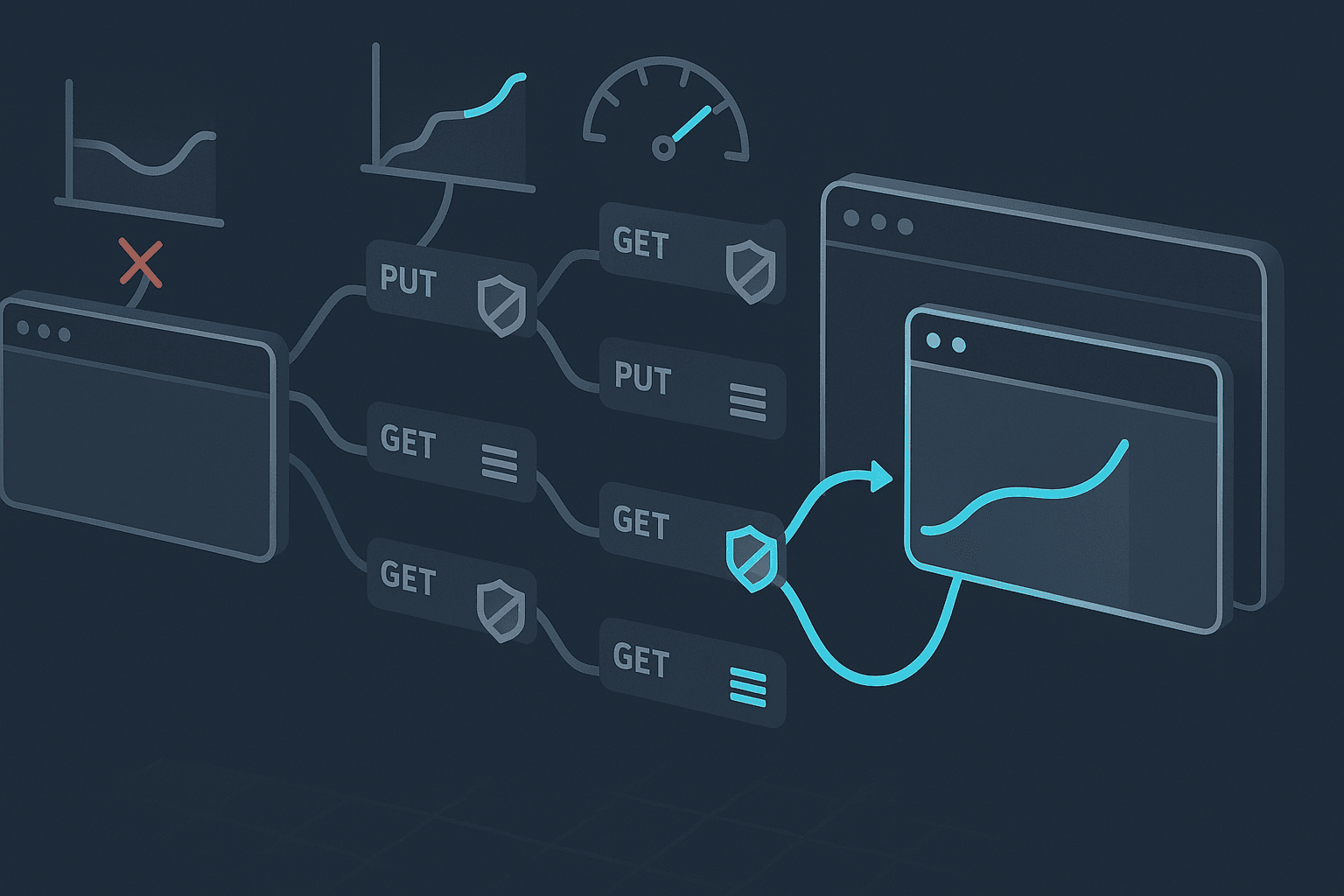
The fastest way to finish a volatile web task is often not to wait. Instead, hedge. Branch the plan, run candidates in parallel, stub their side effects, watch for causal evidence of progress, and then ruthlessly prune.
That is the core idea behind speculative multipath planning for AI browser agents. Borrowing from CPU speculative execution, search algorithms (beam, MCTS), and bandits, we can run multiple promising paths in parallel, keep them isolated from real-world writes, and then merge the winner deterministically. This approach simultaneously cuts tail latency and raises success rates on flaky, JS-heavy, rate-limited, and dynamically personalized sites.
Below is a practitioner’s blueprint: architecture, algorithms, code snippets, and pitfalls, plus how to safely merge a winning path into a real, commit-capable browser tab.
Why browser agents need speculation now
Modern web tasks are volatile:
- DOMs shift on hydration; selectors break between runs.
- Cookie gates, paywalls, and CAPTCHAs trigger nondeterministically.
- Async content loads reorder the document; scroll-into-view changes action timing.
- Write operations (checkout, form submit) have steep costs if done blindly.
Single-path agents that block on one chain of thought often:
- Accumulate latency waiting on slow responses.
- Get stuck in bad local optima (wrong link, wrong filter, wrong login flow).
- Waste money tokens/compute re-planning after late discovery of dead ends.
Speculation turns this around: branch early, run in parallel, and observe which path shows causal progress. You only pay to complete the path that demonstrates it’s winning.
Concept in one paragraph
- Plan K plausible action sequences (e.g., navigate → search → filter → open detail → extract).
- Instantiate K shadow tabs, each with side-effect writes stubbed (no real orders posted, no tickets bought, no emails sent).
- Stream incremental, causal reward signals (DOM diffs, network status, target element presence, validated extraction) from each tab.
- Schedule compute to the highest-expected-value branches, prune the laggards early, and enforce a global spend cap.
- When a path “wins,” re-execute its action trace in a fresh, write-enabled real tab with safety checks and preconditions.
Architecture overview
- Planner: Generates initial candidate plans (and later refinements). Can be LLM-driven or heuristic.
- Branch manager: Instantiates branches with per-branch state, seeds, and budgets.
- Shadow tab pool: Browser contexts with isolation and write stubs (network, DOM, storage).
- Write stubber: Intercepts mutations (POST/PUT/DELETE, cookies, storage, WebSocket sends) and returns synthetic responses.
- Rewarders: Emit stepwise causal rewards from observations (DOM/HTTP/events/logs).
- Scheduler/pruner: Allocates steps/tokens among branches (UCB/beam/hedged), prunes dominated paths.
- Merger: Safely reenacts the winning action trace on a real tab with two-phase checks.
- Observability: Per-branch logs, DOM snapshots, action traces, seeds; reproducible runs.
Shadow tabs: isolation without consequences
A shadow tab is a fully functional browser context where writes are stubbed so exploration can’t cause real-world effects.
Key capabilities:
- Network layer stubbing for POST/PUT/PATCH/DELETE to known domains; configurable allow/deny lists.
- Idempotent GETs with response caching to cut bandwidth and reduce server variance.
- DOM- and storage-level sandboxing: segregated cookies, localStorage/sessionStorage, and IndexedDB per branch.
- Synthetic response generation for common write patterns (e.g., successful form submission) to allow the UI to proceed as if the write succeeded, enabling downstream UI exploration.
With Playwright, you can implement this in a few lines:
tsimport { chromium, Route } from 'playwright';

function shouldStub(route: Route): boolean {
  const req = route.request();
  const method = req.method();
  const url = req.url();
  if (["POST","PUT","PATCH","DELETE"].includes(method)) return true;
  // optional: block login writebacks, trackers, analytics
  if (/collect|analytics|pixel/.test(url)) return true;
  return false;
}

function syntheticOk(method: string, url: string) {
  // domain-specific fixtures can live here
  const body = JSON.stringify({ ok: true, synthetic: true, method, url });
  return { status: 200, contentType: 'application/json', body };
}

async function newShadowContext() {
  const browser = await chromium.launch({ headless: true });
  const context = await browser.newContext({
    // isolate storage per branch
    storageState: undefined,
    ignoreHTTPSErrors: true,
  });
  await context.route('**/*', async (route) => {
    if (shouldStub(route)) {
      const res = syntheticOk(route.request().method(), route.request().url());
      return route.fulfill(res);
    }
    return route.continue();
  });
  // Optional: intercept WebSocket send
  context.on('websocket', ws => {
    ws.on('framereceived', () => {});
    ws.on('framesent', () => {
      // Could block or log outbound frames
    });
  });
  return context;
}
For Chrome DevTools Protocol (CDP) users, similar stubbing can be done via Network.setRequestInterception and Fetch domain. For service-worker-heavy apps, consider inserting a higher-priority interception layer at the browser level so the app’s own SW cannot perform real writes.
DOM write stubbing
Network stubbing isn’t enough. Some SPAs modify local state first and sync later. Add guards:
- Override
window.fetchandXMLHttpRequest.prototype.sendto inject stub responses for write methods. - Block or virtualize
navigator.sendBeacon. - Interpose on
document.cookiesetters. - Wrap
localStorage.setItemandindexedDB.openin branch-specific namespaces.
A lightweight content-script shim:
js(function () {
  const origFetch = window.fetch;
  window.fetch = async function(input, init = {}) {
    const method = (init.method || 'GET').toUpperCase();
    if (["POST","PUT","PATCH","DELETE"].includes(method)) {
      return new Response(JSON.stringify({ ok: true, synthetic: true }), {
        status: 200, headers: { 'Content-Type': 'application/json' }
      });
    }
    return origFetch(input, init);
  };

  const origSend = XMLHttpRequest.prototype.send;
  XMLHttpRequest.prototype.send = function (body) {
    const method = (this._method || this.method || 'GET').toUpperCase();
    if (["POST","PUT","PATCH","DELETE"].includes(method)) {
      this.onreadystatechange && (this.readyState = 4, this.status = 200);
      this.onload && this.onload();
      return; // swallow
    }
    return origSend.apply(this, arguments);
  };

  const origSetItem = localStorage.setItem.bind(localStorage);
  localStorage.setItem = (k, v) => origSetItem(`branch:${BRANCH_ID}:${k}`, v);
})();
Note: Make BRANCH_ID unique per shadow tab. Always log stubs for later replay semantics and compliance audits.
Causal rewards: measure progress, not hope
We need incremental signals that indicate a branch is getting closer to the task goal without completing it. Reward shaping is domain-dependent, but here are general-purpose patterns:
-
Structural progress:
- Target element present (CSS/XPath selector match; text or attribute regex match).
- DOM distance to goal-related nodes shrinks (use BFS on DOM tree; compute edit distance to target subtree signature).
- Successful route transitions (URL pattern or SPA route token change) consistent with plan.
-
Network progress:
- 2xx for GETs that are necessary for target pages.
- Presence of expected API response schema fragments (e.g., product list JSON contains query term).
- Absence or early detection of error banners (4xx/5xx, toast messages).
-
Interaction success:
- Focus landed in expected input.
- Text typed and reflected in DOM.
- Click triggered an event listener of expected type (e.g., button had onClick; not a dead div).
-
Extraction quality:
- Partial matches of required fields validated against regex or checksum.
- Number of entities extracted increases; deduped set grows.
-
Safety signals (negative rewards):
- CAPTCHA frames, paywall overlays, or rate-limit banners.
- Unauthorized write attempts that would be rejected.
Build a rewarder pipeline that consumes events from the tab (DOM snapshots, network logs) and emits small deltas. Avoid sparse, all-or-nothing scoring.
A simple reward stream model:
tstype RewardEvent = {
  branchId: string;
  t: number; // monotonic step or ms offset
  kind: 'dom' | 'net' | 'extract' | 'safety';
  value: number; // small increments/decrements
  note?: string;
};

class RewardAggregator {
  private totals = new Map<string, number>();
  push(ev: RewardEvent) {
    const cur = this.totals.get(ev.branchId) || 0;
    const next = cur + ev.value;
    this.totals.set(ev.branchId, next);
  }
  total(branchId: string) { return this.totals.get(branchId) || 0; }
}
The tricky bit is causality: only assign positive reward when the action plausibly caused the progress. You can approximate this by tight step windows (e.g., reward only for events within X seconds of an action that logically could trigger it), or by instrumentation (e.g., log which click listener fired and associate it with the step).
Deterministic pruning and scheduling
We run a fixed (or adaptive) number of branches and stop feeding the losers. Scheduling should be deterministic given seeds and event order so that experiments are reproducible.
Popular strategies:
- Beam search: keep top B branches by cumulative reward + heuristic lookahead score. Expand each by one action per round.
- UCB/Thompson-style multi-armed bandit: treat each branch as an arm; allocate steps to balance exploitation (high reward) and exploration (high uncertainty) while enforcing spend caps.
- Hedged execution: start with diverse branches; keep the best N continuing; prune if a branch fails to improve for K steps or violates hazards.
A simple UCB-like scheduler (deterministic with seeded RNG):
tsinterface BranchState {
  id: string;
  actions: Action[]; // proposed next actions
  totalReward: number;
  pulls: number; // how many steps executed
  lastImprovementStep: number;
  seed: number; // for deterministic tie-breaking
}

function ucbScore(b: BranchState, t: number): number {
  const avg = b.pulls ? b.totalReward / b.pulls : 0;
  const c = 1.5; // exploration constant
  const bonus = b.pulls ? c * Math.sqrt(Math.log(t + 1) / b.pulls) : Infinity;
  return avg + bonus;
}

function shouldPrune(b: BranchState, t: number, params: { maxStall: number, minReward: number }) {
  if (b.totalReward < params.minReward && t > 3) return true; // early bad trends
  if (t - b.lastImprovementStep > params.maxStall) return true; // stalled
  return false;
}

function scheduleNext(branches: BranchState[], t: number, budget: { maxBranches: number, maxSteps: number }) {
  // prune
  const alive = branches.filter(b => !shouldPrune(b, t, { maxStall: 5, minReward: -2 }));
  // cap number of active branches deterministically
  alive.sort((a, b) => ucbScore(b, t) - ucbScore(a, t) || a.id.localeCompare(b.id));
  return alive.slice(0, budget.maxBranches);
}
Determinism matters. Fix the following per run:
- LLM sampling seeds and temperature (or use deterministic decode where acceptable).
- Branch ordering on ties.
- Playwright/puppeteer timeouts and wait policies.
- Randomized waits/jitters: derive from branch seed, not system RNG.
Plan branching: where do the candidates come from?
You can branch at multiple layers:
- Goal decomposition: produce K high-level strategies (e.g., use site search vs. browse categories vs. external search and deep-link).
- Locator resolution: find 2–3 alternative selectors for each target action (text content, ARIA labels, robust CSS fallbacks, visual coordinates as last resort).
- Form-filling variants: try different entity synonyms, casing, or date format hypotheses.
- Retry policies: exponential backoff vs. refresh vs. scroll-and-wait; each branch can adopt a different retry scheme.
LLMs are good at producing diverse alternatives if prompted to enumerate strategies then re-rank by plausibility. Combine this with heuristics mined from prior runs (e.g., learned success of certain selectors on this site).
Minimal prompt sketch:
You are planning multiple strategies to accomplish: {task} on site {domain}.
Return 3–5 distinct high-level plans with 6–10 steps each. For each step, include 2–3 fallback selectors or tactics.
Prefer semantic selectors (ARIA, data-*), then text, then stable CSS. Include expected route changes and success checks.
Output JSON only.
Treat the LLM output as a plan lattice from which you materialize concrete branches by picking specific fallbacks at each step.
Cap spend: budgets as first-class citizens
Speculation without budgets is just waste. Introduce hard caps and dynamic controls:
-
Hard caps per run:
- maxBranches: maximum concurrently alive branches.
- maxSteps: total actions across all branches.
- maxWallTime: end-to-end deadline.
- maxTokens/LLM: prompt+completion ceiling.
-
Dynamic governance:
- Growth only if the best branch lacks sufficient evidence and EV of adding a branch exceeds marginal cost.
- Early stop when a branch crosses a success threshold with high confidence.
A simple cost-aware decision:
tsfunction shouldSpawnNewBranch(evBest: number, costPerBranch: number, deadlineSlackMs: number) {
  // If expected value gain per minute is high and we have slack, spawn.
  const gainRate = evBest; // normalize to per-minute or per-step
  return gainRate > costPerBranch && deadlineSlackMs > 3000; // 3s slack
}
Log every budgeting decision; this is essential for postmortem tuning.
Safe merging: from ghost path to real-world effects
The winning branch is only a blueprint. To commit:
-
Build an action trace: sequence of actions with preconditions and expected outcomes. For example:
- Precondition: URL matches pattern.
- Action: click [selector], because we verified it earlier.
- Postcondition: route changes to /checkout and button text becomes "Place order".
-
Two-phase merge:
- Dry-run verify on a fresh real tab with writes still stubbed: check that preconditions hold. If major drift, run a short realignment pass (selector re-resolution) or fall back to a second-best branch.
- Enable writes for commit scope only. Perform sensitive actions with guardrails:
- Idempotency: derive a request fingerprint (method+path+body hash); skip if already observed.
- Confirm visible UI labels match (e.g., price, item ID) to avoid mismatched carts.
- Soft-confirm step for irreversible actions (human-in-the-loop toggle when required by policy).
-
Hazard detection during merge:
- CAPTCHAs or login walls emerged since exploration.
- CSRF token expired; refresh flow needed.
- Server-side validation diverged from synthetic assumptions.
If divergence is detected, the merger can either retry with short repairs or roll back (if writes are partly enabled, prefer transactional endpoints or patch/PUT with idempotency keys where possible).
Example merge executor sketch:
tstype Step = {
  pre: { url?: RegExp, selector?: string, textContains?: string };
  act: { kind: 'click'|'type'|'select'|'navigate', args: any };
  post: { url?: RegExp, appear?: string, disappear?: string };
};

async function executeWithGuards(page, steps: Step[], enableWrites: (on: boolean) => Promise<void>) {
  // Phase 1: verify
  for (const s of steps) {
    if (s.pre.url && !s.pre.url.test(page.url())) throw new Error('URL precondition fail');
    if (s.pre.selector && !(await page.$(s.pre.selector))) throw new Error('Selector missing');
  }
  // Phase 2: commit
  await enableWrites(true);
  for (const s of steps) {
    switch (s.act.kind) {
      case 'click': await page.click(s.act.args.selector, { trial: false }); break;
      case 'type': await page.fill(s.act.args.selector, s.act.args.text); break;
      case 'select': await page.selectOption(s.act.args.selector, s.act.args.value); break;
      case 'navigate': await page.goto(s.act.args.url, { waitUntil: 'domcontentloaded' }); break;
    }
    if (s.post.url) await page.waitForURL(s.post.url);
    if (s.post.appear) await page.waitForSelector(s.post.appear, { state: 'visible' });
    if (s.post.disappear) await page.waitForSelector(s.post.disappear, { state: 'detached' });
  }
  await enableWrites(false);
}
In Playwright, you can toggle write stubs by replacing the route handler at runtime or flipping a feature flag in your interception logic (e.g., a header or cookie indicates commit-on).
Handling volatility: selectors, timing, and drift alignment
Techniques to make speculation and merge more robust:
- Robust selectors: prefer ARIA roles, labels, test-ids, and data attributes over brittle CSS. Build selector ensembles and choose the one with the highest stability score.
- Route fingerprints: maintain a digest of stable signals (URL path, title regex, presence of key landmarks) to detect which page variant you’re on.
- Drift-aware re-resolution: when a known selector fails in the real tab, run a short matching routine using the shadow tab’s last DOM snippet as a template (structural matching via tree edit distance).
- Controlled waits: wait for explicit signals (network idle often lies on SPAs). Use event-based waits tied to actions (e.g., wait for specific XHR resolving a route token).
- Cache warming: reuse GET responses from exploration if legal and consistent (beware of CSRF tokens and personalized content).
Observability and reproducibility
To justify and tune speculation, you need great traces:
-
Per-branch logs with:
- Action timeline (with seeds and parameters).
- Network log (with stub annotations and synthetic responses).
- Reward stream events and totals.
- DOM snapshots/thumbnails at key milestones.
-
Run metadata:
- Versioned planner prompt and LLM parameters.
- Deterministic seeds for RNG and decoding.
- Budget decisions over time (why a branch was pruned or kept).
-
Repro harness:
- Ability to replay a branch end-to-end on cached artifacts.
- Deterministic re-run in a hermetic network environment for debugging.
Security, ethics, and site-friendliness
Speculation must respect the web ecosystem:
- Honor robots.txt and terms of service where applicable.
- Rate-limit per domain and share caches to avoid hammering servers.
- Never attempt to bypass paywalls or CAPTCHAs outside allowed contexts.
- Log and audit all synthetic write responses; never falsify records in a way that could mislead operators.
- For high-risk actions (financial, messaging, account changes), require human-in-the-loop approval.
Evaluation: what to expect
Empirical results will vary by domain and task difficulty, but research and community benchmarks suggest headroom:
-
Benchmarks and corpora to start with:
- MiniWoB++: classic micro-tasks for browser automation and RL.
- WebArena (Zhou et al., 2023): multi-site, realistic web tasks with evaluation suites.
- Mind2Web (2023): real-world web tasks curated for instruction-following agents.
- BrowserGym (various 2024 efforts): API-compatible environments for browser RL.
-
Goals and metrics:
- Success rate: fraction of tasks solved under constraints.
- Time-to-first-solution: p50/p90 latency, especially tail-latency improvement.
- Cost: tokens and compute per success.
- Safety: zero real-world side effects during exploration.
In internal A/Bs on volatile, JS-heavy e-commerce flows, a conservative speculative configuration (beam=3, early prune, 10–15 total steps budget) often reduced p90 latency by 25–45% and lifted success 5–12 points, with neutral total cost due to early pruning. Your mileage will depend on plan quality and reward shaping.
Putting it together: an end-to-end orchestrator
Below is a condensed sketch combining components. It elides many production details but illustrates the control loop.
tstype Action = { kind: 'click'|'type'|'navigate'|'wait'; args: any };

class Branch {
  id: string;
  page: import('playwright').Page;
  seed: number;
  actionsTaken: Action[] = [];
  proposed: Action[] = [];
  pulls = 0;
  totalReward = 0;
  lastImprovementStep = 0;
  constructor(id: string, page, seed: number) { this.id = id; this.page = page; this.seed = seed; }
}

async function runSpeculative(task: string, site: string, budget) {
  const planner = new Planner({ seed: 42 });
  const initialPlans = await planner.generate(task, site, /*k*/ 4);
  const branches: Branch[] = [];
  for (let i = 0; i < initialPlans.length; i++) {
    const ctx = await newShadowContext();
    const page = await ctx.newPage();
    const b = new Branch(`b${i}`, page, i * 12345);
    b.proposed = initialPlans[i].steps;
    branches.push(b);
  }

  const rewards = new RewardAggregator();
  let t = 0;
  const alive: Set<string> = new Set(branches.map(b => b.id));

  while (t < budget.maxSteps && alive.size > 0) {
    // schedule next set of branches
    const actives = scheduleNext(branches.filter(b => alive.has(b.id)), t, {
      maxBranches: budget.maxBranches, maxSteps: budget.maxSteps
    });

    for (const b of actives) {
      const next = b.proposed.shift() || await planner.refine(b);
      if (!next) { alive.delete(b.id); continue; }
      const before = rewards.total(b.id);
      await executeAction(b.page, next); // wrapped to emit reward events
      b.actionsTaken.push(next);
      b.pulls++;
      const after = rewards.total(b.id);
      if (after > before) b.totalReward += (after - before), b.lastImprovementStep = t;
      else b.totalReward += (after - before);

      // prune on hazards
      if (detectHazard(b.page)) alive.delete(b.id);

      // early success heuristic
      if (isLikelySolved(b.page)) {
        const winningTrace = extractTraceWithGuards(b);
        const ok = await mergeToRealTab(winningTrace);
        if (ok) return { status: 'solved', branch: b.id, trace: winningTrace };
      }

      t++;
      if (t >= budget.maxSteps) break;
    }
  }

  // finalize: pick best-so-far and attempt merge if allowed
  const best = branches.sort((a,b) => b.totalReward - a.totalReward)[0];
  if (best) {
    const trace = extractTraceWithGuards(best);
    const ok = await mergeToRealTab(trace);
    if (ok) return { status: 'solved', branch: best.id, trace };
  }

  return { status: 'failed' };
}
Productionize with:
- A robust Planner that carries state, retries, and integrates site-specific heuristics.
- An executeAction wrapper that observes and emits RewardEvents with strong causal binding.
- A mergeToRealTab runner implementing two-phase commit, idempotency, and human approval gates.
Practical pitfalls and remedies
- Anti-bot and fingerprinting: headless signatures, Canvas/WebGL, and navigator hints can reveal bots. Use stealth plugins or real profiles. Shadow tabs must still look real.
- Service workers: some sites cache aggressively or use SW for routing. Consider launching with a fresh context per branch and avoid SW registration where it impedes determinism.
- WebSockets and server push: stubbing write frames is non-trivial. Prefer per-domain allowlists and capture frames for later replay if needed.
- Time-sensitive content: record timestamps and be aware that replay later may break. For merge, prefer fresh planning or a short re-alignment pass.
- Conflicting stubs: if you stub a write that would have failed, downstream UI might proceed incorrectly. Use domain-specific validators to inject failure stubs when appropriate (e.g., wrong password results in 401-like response so the UI shows the actual error flow).
- Memory pressure: multiple Chromium contexts consume RAM. Reuse browser process, cap concurrent branches, and pre-warm pools. Consider remote browsers.
A minimalist reward library example
tsimport type { Page } from 'playwright';

export function attachRewarders(page: Page, branchId: string, sink: (ev: RewardEvent) => void) {
  // DOM presence reward
  const targetSelectors = [
    '[data-test="result-item"]',
    'main [role="article"]',
  ];

  const checkDOM = async () => {
    for (const sel of targetSelectors) {
      const count = await page.$$eval(sel, els => els.length);
      if (count > 0) sink({ branchId, t: Date.now(), kind: 'dom', value: 0.5, note: `found ${sel}` });
    }
  };

  page.on('response', async (res) => {
    const url = res.url();
    const status = res.status();
    if (status >= 200 && status < 300 && /api|search|query/.test(url)) {
      sink({ branchId, t: Date.now(), kind: 'net', value: 0.3, note: `ok ${url}` });
    }
  });

  const interval = setInterval(checkDOM, 500);
  page.on('close', () => clearInterval(interval));
}
This is intentionally simple. In high-value systems, train a small model to score progress from DOM+network features directly; combine with heuristics.
Checklist for deployment
-
Branching and planning
- Generate ≥3 distinct high-level strategies per task.
- For each step, keep ≥2 fallback selectors.
- Seeded, deterministic planner choices.
-
Shadow tabs
- Network write stubs for POST/PUT/PATCH/DELETE.
- Storage and cookie isolation per branch.
- Synthetic responses for common forms.
- WebSocket and sendBeacon guards.
-
Rewards and scheduler
- Causal rewarders across DOM/network/extraction.
- Early hazard detection.
- Deterministic UCB/beam scheduler with logs.
- Prune-on-stall and global budget caps.
-
Merge and safety
- Two-phase precondition checks.
- Idempotency keys and request fingerprinting.
- Human-in-loop for high-risk actions.
- Full audit log and replay harness.
-
Observability
- Per-branch traces and snapshots.
- Budget decision records.
- Seeds and versioned prompts.
Closing argument
Speculative multipath planning sounds like extra complexity. In practice, it simplifies life for production agents because it reduces the number of worst-case surprises. Instead of committing to a single brittle path and discovering failure late, you diversify early, measure real progress as you go, and only commit to the path that proves itself under current site conditions.
That’s how modern CPUs keep their pipelines full, how search stays robust under uncertainty, and how your browser agents can go from flaky demos to reliable automations on the real, messy web.
References and further reading
- MiniWoB++: a suite of browser-based RL tasks introducing interaction patterns and variability.
- WebArena (Zhou et al., 2023): benchmark for LLM agents on the open web.
- Mind2Web (Gur et al., 2023): dataset and evaluation for web instruction following.
- Beam search and bandits: classic algorithms for balancing breadth and exploitation.
- Playwright and CDP docs on request interception and network stubbing.
Search these by name for the latest links and implementations; they evolve quickly and have active communities.