
Executive summary
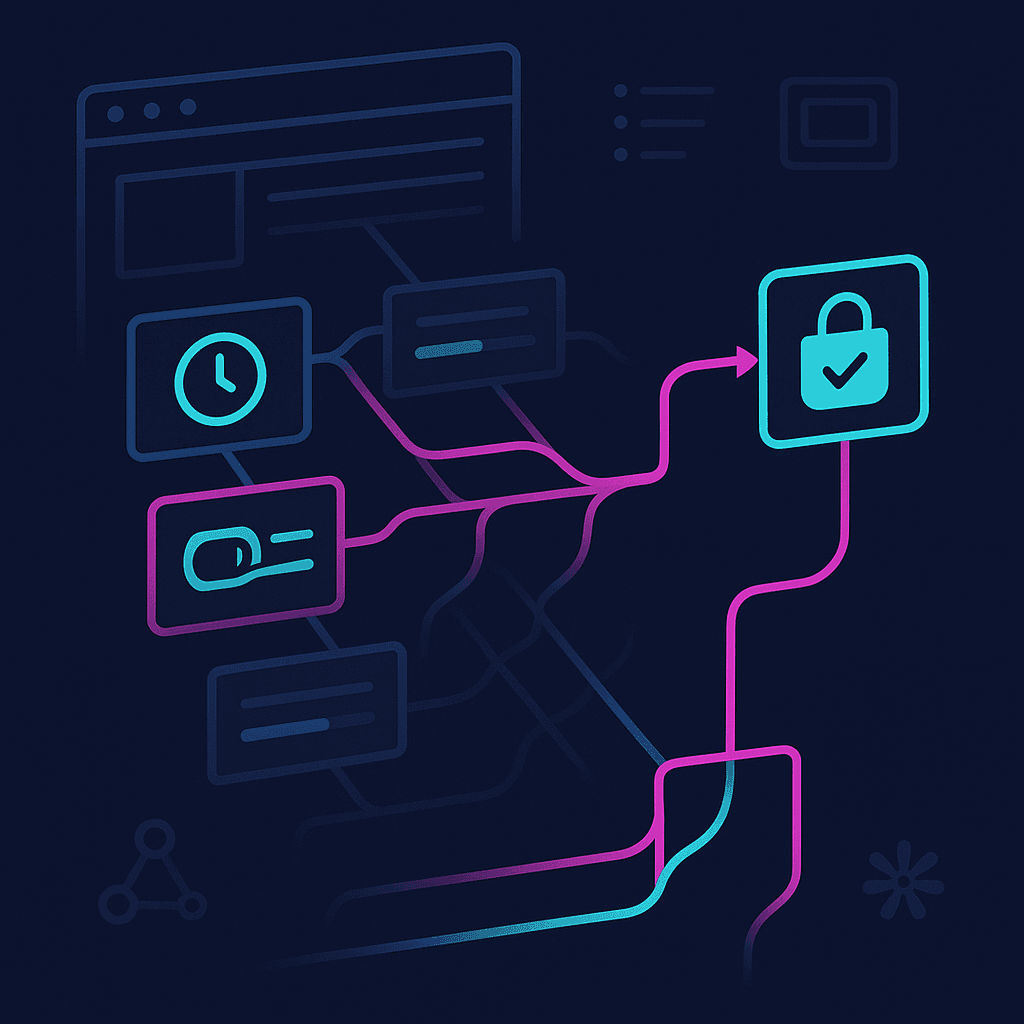
Speculative multiverse planning turns a single-threaded browser agent into a controlled swarm: the agent spawns parallel tabs (or isolates), explores multiple candidate action branches simultaneously, evaluates their progress using causal success metrics, and prunes branches that exceed cost or latency budgets. When a winning branch emerges, the system deterministically commits a single path using idempotent writes and records a replayable audit log that can reconstruct, verify, or critique every step. The result is a system that is faster than naive sequential agents, safer than unconstrained tool-use LLMs, and ultimately more debuggable and auditable.
This article provides a complete blueprint: conceptual model, concrete architecture with Playwright or Chrome DevTools Protocol (CDP), scoring and pruning strategies, determinism techniques, and code-level patterns. The intended audience is engineers building reliable autonomous browsing tools for tasks like procurement, research, form submission, onboarding, QA, or RPA.
Why speculative multiverse planning for browser agents
Traditional browser automation proceeds linearly: the agent tries an action, waits, and adapts. This is slow and brittle for tasks with branching ambiguity, such as which filter to apply, which form field to try, or which navigation path goes around a soft paywall or login wall. Speculative multiverse planning accelerates and de-risks exploration by:
- Parallelizing uncertainty: test multiple next steps concurrently in isolates.
- Reducing idle latency: overlap network waits and animation frames.
- Quantifying progress: track causal progress signals to avoid being misled by superficial activity.
- Budget control: enforce global caps on compute, network cost, and time with early pruning.
- Deterministic finalization: commit exactly one branch in a safe and repeatable way.
- Full replay: log everything to support root-cause analysis, compliance, and learning.
Compared to naive parallelism, the multiverse approach is structured: it treats branches as first-class citizens, with reproducible seeds, scored states, and a deterministic selection and commit protocol that avoids double submissions or inconsistent state.
Core mental model
- State: a browser tab state is the DOM, JS heap, cookies, storage, network condition, and any ephemeral UI state.
- Action: a user-like operation such as click, type, select, scroll, or JS snippet.
- Branch: a path through the action tree, with its own PRNG seed, environment constraints, and trace.
- Multiverse: a frontier set of candidate branches explored in parallel.
- Budgets: time, monetary cost (e.g., paid API calls), and compute envelope.
- Causal success metrics: goal-progress signals that attempt to measure whether an action caused improvement toward the objective, not just correlation.
- Safe-merge: deterministically pick one branch and apply only its side effects with idempotent writes.
- Replay: the entire process is event-sourced for auditing and reproduction.
System architecture
The architecture decomposes into four planes:
- Control plane
- Orchestrator: manages the search frontier, assigns branches to workers, tracks budgets and scores.
- Scheduler: enforces concurrency levels and prioritization (e.g., best-first or bandit-driven).
- Policy: decides when to expand, when to prune, and when to commit.
- Execution plane
- Worker pool: N browser contexts (e.g., Playwright with persistent contexts or CDP targets) each running one branch at a time.
- Sandbox and isolation: each branch runs in its own incognito profile, service worker partition, and PRNG seed.
- Deterministic inputs: stable viewport, timezone, locale, and network throttling.
- Observation plane
- Instrumentation: DOM snapshots, network HAR, screenshots, console logs, performance timeline, accessibility tree.
- Progress detectors: CSS or XPath selectors, regexes over text, learned extractors, micro-evaluators.
- Causal probes: micro-interventions to test whether observed changes reflect true progress.
- Data plane
- Event store: append-only event log with strong ordering (e.g., Kafka, NATS JetStream, or SQLite WAL for small setups).
- Artifact store: snapshots, traces, screenshots, HAR files; content addressed (e.g., S3 + SHA256 keys).
- Commit ledger: write-intent records with idempotency keys and outcomes.
Representation: plans, branches, and states
Define a Branch as an immutable plan prefix plus an execution trace:
- branch_id: stable UUIDv7 or ULID; encodes creation time for ordering.
- parent_id: the branch it forked from (or null for the root).
- plan_digest: a hash of the action sequence and configuration.
- seed: 64-bit PRNG seed used for all nondeterminism inside the branch (action jitter, scrolling offsets, focus order).
- budget: remaining time and cost.
- score: multi-objective vector (progress, confidence, risk, cost so far, ETA).
- trace: ordered events (action_start, action_end, dom_snapshot, network_request, metric_update, error). Each event references content-addressed artifacts.
Plan digests allow detection of repeated recipes and facilitate caching and replay. The seed ensures consistent micro-behavior: for example, the same minor scroll increments or random delays.
Parallel tabs and isolation
To run branches concurrently without cross-talk or pollution:
- Use browser contexts instead of just new tabs. Contexts isolate cookies, storage, and service workers.
- Freeze target configuration: viewport, device scale factor, timezone, user agent, accept-language, and network throttle. This reduces variation in layout and timing.
- Deterministic randomness: wrap Math.random and other sources with a seeded PRNG for in-page scripts you control; drive agent-side randomness exclusively via seeded utilities.
- Network isolation: optionally route each context through a per-branch proxy to segment caches. For deterministic replay, capture responses (via CDP Network.* or Playwright routing) and enable record-replay.
- DOM snapshotting: CDP DOMSnapshot.captureSnapshot can produce a structured snapshot for visual regression and semantic analysis.
Causal success metrics
Browser agents often confuse activity with progress. For instance, a click that opens an overlay may increase DOM mutations but not move toward the goal. Causal success metrics aim to estimate whether a specific action caused positive movement toward the task objective.
Core techniques:
- Explicit goal predicates: define crisp conditions such as visible(selector), value(field) equals target, URL matches regex, or presence of a confirmation token. These are easy to attribute to actions.
- Contrastive deltas: compute delta metrics immediately before and after an action in the same branch (within a short window) to attribute change to the action.
- Micro-ablation: selectively reverse or avoid a redundant follow-up action in a cheap cloned micro-branch to see if progress persists. For example, if you typed a field, does the subsequent auto-save appear only following the type event?
- Causal graph templates: for common workflows (login, search, checkout), define a DAG of expected causal relations (enter email should enable password field, submit should trigger request pattern to auth endpoint) and score branches by their compliance.
- Network-grounded signals: binding UI progress to network requests e.g., GraphQL mutation result with success flag or HTTP 2xx from a known endpoint following a submit.
- Latency-adjusted outcomes: apply discounting for late outcomes to reflect budget opportunity cost, akin to time-discounted reward.
Scoring function example (vector then scalarized):
- s_progress in [0,1]: fraction of goal predicates satisfied.
- s_confidence in [0,1]: reliability of detections (detector calibration; ensemble agreement).
- s_risk in [0,1]: likelihood of irreversible or harmful side-effects estimated from heuristic or learned classifier (e.g., submitting a live order).
- cost_so_far: estimated resource cost (API calls, token usage, bandwidth) normalized.
- eta: predicted remaining steps.
Aggregate score example: maximize J = w1s_progress + w2s_confidence - w3s_risk - w4normalized_cost - w5*time_discount, subject to budgets. Multi-objective scheduling can prefer Pareto-efficient branches rather than a single scalar.
Budget-aware pruning
Budgets prevent a speculative explosion.
Budget types:
- Wall-clock: global time limit per task and per branch.
- Monetary: cap API spend, paid data APIs, or token usage per task.
- Compute: limit CPU time or concurrent workers.
- Interaction: cap maximum steps per branch.
Pruning strategies:
- Early termination when branch score lags behind the frontier by a margin for N successive expansions.
- Cost-aware expansion: only expand the top-K promising branches per unit expected improvement divided by expected marginal cost (a best bang-for-buck heuristic).
- Beam search with dynamic width: start wide, narrow as signals clarify.
- Anytime MCTS variant: treat actions as edges, reward from causal metrics; use UCT with cost-aware priors; cut children when upper confidence bound plus budget slack falls below a threshold.
- Forced diversification: reserve a fraction of expansions for diverse branches to reduce premature convergence.
Implementation detail: maintain a min-heap keyed by negative utility per marginal cost, update on every metric update, and time-slice workers with a cooperative scheduler. Workers should regularly yield control (e.g., after each navigation settled or idle network) for the orchestrator to reassess.
Deterministic safe-merge
Speculation is only valuable if the final commit is safe and reproducible. Deterministic safe-merge consists of:
- Candidate selection: deterministically pick the winner branch based on ordered criteria: highest score, lowest cost, earliest finish; tie-break with branch_id ordering. No randomness at selection time.
- Single-writer discipline: only one component (the Committer) is allowed to perform side-effectful operations against the outside world.
- Idempotency: every write is guarded by an idempotency key derived from the branch plan_digest, the side-effect type, and the input payload hash. Servers must treat repeated keys as safe retries.
- Pre-flight verification: before performing a write, the Committer validates that the preconditions still hold (e.g., cart price unchanged, CSRF token valid). If not, it can either adapt via a saga compensating action sequence or abort and fall back to the next best branch.
- Read-then-compare-and-swap: when feasible, use APIs or DOM interactions that allow compare-and-swap semantics (conditional updates only if version matches).
- Deterministic replay binding: the final commit references precise artifacts (snapshots, HARs, screenshots) and seeds so another machine can replay and verify the outcome.
Consistency model: treat multiverse exploration as read-only until commit. The commit sequence is a small, auditable write transaction that is either fully applied or rolled back via compensation. To guarantee determinism, the set of operations and their order is purely a function of the selected branch trace and a frozen environment configuration.
Idempotent writes in the wild
- HTTP APIs: include Idempotency-Key header; servers should respond with the same result on retried keys. If the site lacks first-class idempotency support, emulate with a stable unique payload marker field where possible (e.g., client_order_id).
- HTML forms: store a hidden field or anchor with a stable client reference; on success pages, detect and record a confirmation token; on retry, check for existing confirmation.
- Payment-like flows: never auto-submit payment in speculation. The speculative exploration stops at a pre-commit boundary (e.g., review page) and the Committer executes the final submit with idempotency in place.
- Document uploads: compute content hashes and store them with metadata so duplicates are recognized.
Replayable audit logs
A replayable log is an event-sourced record of everything meaningful:
- Events: action_start, action_end, nav_start, nav_end, dom_snapshot, metric_update, branch_fork, branch_pruned, budget_update, error, commit_start, commit_end.
- Correlation: W3C trace context style fields (trace_id, span_id, parent_span_id) to correlate events across branches and workers.
- Artifacts: binary or large artifacts (HAR, MHTML, screenshots, DOMSnapshot, console dumps) stored with content addressing; events reference artifact hashes.
- Deterministic seeds: record seed, environment fingerprint (browser build, OS, timezone, UA), viewport, extension set, proxy info.
- Tool calls: when using LLM tool usage or function calls, store arguments and normalized tool outputs.
Replay modes:
- Visual: step through screenshots strobing before and after actions.
- Deterministic: boot a headless browser with the same seeds and serve recorded responses via a local replay proxy to reconstruct the DOM states.
- Analytical: recompute metrics from snapshots to check that the same branch still wins under the same policy.
End-to-end example: procure a developer tool subscription
Task: given a vendor website, purchase a team plan for 10 seats under a monthly budget and obtain an invoice PDF.
Plan outline:
- Root: open homepage; detect pricing link; branch across various pricing navs (top nav, footer, hamburger, search).
- Parallel branches: in separate contexts, try each path and explore toggling monthly vs annual, business vs team plans.
- Causal metrics: detect presence of unit price, seat selector, VAT field for EU, and final review page.
- Budget: limit to 120 seconds wall-clock and 100 API calls.
Speculative exploration:
- Branch A: finds pricing, clicks Team, lands on checkout with seat incrementor. Types 10, clicks Continue. Progress 0.6.
- Branch B: tries enterprise contact; leads to a form without self-serve checkout. Progress 0.2; prune early.
- Branch C: opens support docs; progress 0.1; prune.
- Branch D: finds plan but toggles annual; cost exceeds budget; penalize and defer.
Pruning:
- A and D survive first beam. Because D is over budget threshold after applying discounts, it is deprioritized.
- Branch A continues to final review page with clear line items and a visible confirmation predicate. Progress 0.9 with high confidence.
Safe-merge boundary:
- Define commit boundary as the review page with form data prepared but not yet charged.
- Committer validates cart total and VAT; generates idempotency key commit:vendorX:plan_team:seats_10:subtotal_hash and verifies no prior confirmation exists.
- Commit action: submit with key and wait for server 2xx or confirmation token pattern on the page.
- Post-commit: capture invoice link, download PDF, hash it, and store in artifact store.
Replay:
- The final ledger entry contains the branch id, the precise DOM snapshot before submit, the HAR of the submit request/response, and the confirmation screenshot. A replayer can mount the pre-submit DOM, simulate the submit over a stub that replays the recorded 2xx response, and verify the page content matches.
Implementation sketch with Playwright workers
Below is a minimal orchestrator and worker pool skeleton in TypeScript. It omits many production concerns but shows the moving parts.
tsimport { chromium, Browser, BrowserContext, Page } from 'playwright';
import crypto from 'crypto';

// Types
interface Branch {
  id: string;
  parentId?: string;
  planDigest: string;
  seed: number;
  budgetMs: number;
  budgetCost: number;
  score: number;
  depth: number;
  actions: Action[];
}

interface Action {
  kind: 'click' | 'type' | 'scroll' | 'eval' | 'navigate';
  selector?: string;
  text?: string;
  url?: string;
}

interface Result {
  branchId: string;
  events: any[];
  metrics: { progress: number; confidence: number; risk: number; cost: number };
  snapshots: string[]; // artifact hashes
}

// Simple seeded PRNG
function mulberry32(a: number): () => number {
  return function() {
    let t = (a += 0x6D2B79F5);
    t = Math.imul(t ^ (t >>> 15), t | 1);
    t ^= t + Math.imul(t ^ (t >>> 7), t | 61);
    return ((t ^ (t >>> 14)) >>> 0) / 4294967296;
  };
}

function digestPlan(actions: Action[]): string {
  const s = JSON.stringify(actions);
  return crypto.createHash('sha256').update(s).digest('hex').slice(0, 16);
}

class Worker {
  browser!: Browser;
  busy = false;

  async init() {
    this.browser = await chromium.launch({ headless: true });
  }

  async run(branch: Branch): Promise<Result> {
    this.busy = true;
    const context = await this.browser.newContext({
      viewport: { width: 1280, height: 800 },
      locale: 'en-US',
      timezoneId: 'UTC',
      userAgent: 'MultiverseAgent/1.0',
    });
    const page = await context.newPage();
    const rand = mulberry32(branch.seed);

    const events: any[] = [];
    const snapshots: string[] = [];
    let cost = 0;

    // Instrumentation
    page.on('request', req => {
      events.push({ t: Date.now(), type: 'req', url: req.url(), method: req.method() });
    });
    page.on('response', res => {
      events.push({ t: Date.now(), type: 'res', url: res.url(), status: res.status() });
    });

    for (const a of branch.actions) {
      const start = Date.now();
      events.push({ t: start, type: 'action_start', a });
      try {
        if (a.kind === 'navigate' && a.url) await page.goto(a.url, { waitUntil: 'domcontentloaded' });
        if (a.kind === 'click' && a.selector) await page.click(a.selector, { trial: false });
        if (a.kind === 'type' && a.selector && a.text) await page.fill(a.selector, a.text);
        if (a.kind === 'scroll') await page.mouse.wheel(0, Math.floor(rand() * 600) + 200);
        if (a.kind === 'eval') await page.evaluate(() => {});
      } catch (e) {
        events.push({ t: Date.now(), type: 'action_error', a, error: String(e) });
        break;
      }
      // Snapshot after each action
      const png = await page.screenshot({ fullPage: false });
      const hash = crypto.createHash('sha1').update(png).digest('hex');
      snapshots.push(hash);
      events.push({ t: Date.now(), type: 'snapshot', hash });

      cost += 1; // simplistic cost per action
      const elapsed = Date.now() - start;
      if (elapsed > branch.budgetMs || cost > branch.budgetCost) break;
    }

    // Simple metric: is there a review or confirmation indicator?
    const html = await page.content();
    const containsReview = /Review|Confirm|Order Summary/i.test(html);
    const metrics = {
      progress: containsReview ? 0.8 : 0.2,
      confidence: containsReview ? 0.7 : 0.3,
      risk: /Pay|Charge|Complete Purchase/i.test(html) ? 0.7 : 0.2,
      cost,
    };

    await context.close();
    this.busy = false;
    return { branchId: branch.id, events, metrics, snapshots };
  }
}

class Orchestrator {
  workers: Worker[] = [];
  frontier: Branch[] = [];
  results: Map<string, Result> = new Map();
  budgetWallClockMs = 120_000;
  start = Date.now();

  async init(nWorkers = 4) {
    for (let i = 0; i < nWorkers; i++) {
      const w = new Worker();
      await w.init();
      this.workers.push(w);
    }
  }

  enqueue(actions: Action[], parent?: Branch) {
    const b: Branch = {
      id: crypto.randomUUID(),
      parentId: parent?.id,
      planDigest: digestPlan(actions),
      seed: Math.floor(Math.random() * 2 ** 32),
      budgetMs: 5000,
      budgetCost: 20,
      score: 0,
      depth: actions.length,
      actions,
    };
    this.frontier.push(b);
  }

  selectNext(): Branch | undefined {
    // naive best-first by depth (prefer shallower early)
    this.frontier.sort((a, b) => a.depth - b.depth);
    return this.frontier.shift();
  }

  async run() {
    while (Date.now() - this.start < this.budgetWallClockMs) {
      const idle = this.workers.find(w => !w.busy);
      const next = this.selectNext();
      if (!idle || !next) {
        await new Promise(r => setTimeout(r, 50));
        continue;
      }
      idle.run(next).then(res => {
        this.results.set(res.branchId, res);
        const score = res.metrics.progress + 0.5 * res.metrics.confidence - 0.7 * res.metrics.risk - 0.01 * res.metrics.cost;
        // expand promising branches (toy example)
        if (score > 0.3 && next.depth < 6) {
          this.enqueue([...next.actions, { kind: 'scroll' }], next);
        }
      });
    }
  }
}

(async () => {
  const orch = new Orchestrator();
  await orch.init(4);
  orch.enqueue([{ kind: 'navigate', url: 'https://example.com' }]);
  orch.enqueue([{ kind: 'navigate', url: 'https://example.com/pricing' }]);
  await orch.run();
  // Deterministic selection
  const entries = [...orch.results.entries()];
  entries.sort((a, b) => {
    const sa = a[1].metrics.progress - a[1].metrics.risk;
    const sb = b[1].metrics.progress - b[1].metrics.risk;
    if (sb !== sa) return sb - sa;
    return a[0].localeCompare(b[0]);
  });
  const winner = entries[0];
  console.log('winner_branch', winner?.[0]);
})();
This toy orchestrator uses naive heuristics but illustrates key hooks: seeded randomness, budget checks, metric extraction, and deterministic selection. In production, replace selection with a true multi-objective scheduler and install comprehensive logging.
Determinism engineering checklist
- Freeze environment: versions, flags, viewport, locale, timezone, anti-fingerprinting options.
- Seed everything: agent-side randomness, action delays, micro-scrolls, tab creation order.
- Stabilize detection: use temperature-zero LLM calls or deterministic string-matching for critical predicates. Consider ensemble voters with deterministic tie-breaking.
- Control network: capture and, if needed, replay responses for analysis; stable DNS; optional proxy pinning.
- Deterministic tie-breakers: when multiple branches tie, sort by plan_digest then branch_id.
- Make merges pure functions: commit plan is a pure function of selected trace plus static config; no ad-hoc runtime choices.
Scoring and causal probes in practice
- Selector-based signals: for example, visible('#review-summary') turning from false to true immediately following a click on '#continue'. Attach a causal confidence increment when the state change follows expected latency bounds (e.g., network idle within 2s).
- Network patterns: define expected request shapes for login or checkout flows; for instance, POST to /api/checkout returning JSON with order_id.
- Blocklist regressors: penalize evidence of dead-ends or distractions, e.g., presence of captcha, newsletter modal, or generic 404 copy.
- Micro-branch perturbations: from a branch state, spin a short-lived sibling that omits a no-op action; if progress remains identical, reduce the parent branch credit for that action.
Budgeting patterns
- Soft vs hard limits: treat soft limits as utility penalties that grow quickly near the cap; only hard-abort on true hard limits.
- Budget accounting events: emit budget_debit after every measured cost; persist cumulative counters in the event log.
- Opportunistic yield: after every major navigation or when no significant DOM mutation is observed for a period, ask the scheduler if the branch should keep its worker or yield to a higher-utility branch.
Commit protocol sketch
- Freeze winner: stop expanding other branches and signal workers to quiesce.
- Validate preconditions: re-check the DOM and, if possible, re-GET the review resource to confirm version and totals; compare with saved snapshot; compute diff budget.
- Generate idempotency key: a canonical string like commit:site_slug:flow_slug:plan_digest:payload_hash; store in ledger as write_intent.
- Perform writes: submit the form or call the API; include key via header or hidden field; record request and response.
- Confirm success: extract confirmation tokens and artifacts; check invariants.
- Finalize ledger: mark the write_intent as committed with outcome metadata and link artifacts.
- Publish replay bundle: assemble minimal artifacts for third-party verification.
If any step fails deterministically (e.g., price mismatch), optionally try the next-best branch if it has not expired and can satisfy updated preconditions.
Event log data model (TypeScript interfaces to avoid JSON quoting)
tsinterface TraceEvent {
  t: number; // epoch millis
  kind: 'action' | 'nav' | 'dom' | 'net' | 'metric' | 'budget' | 'error' | 'fork' | 'prune' | 'commit';
  traceId: string;
  spanId: string;
  parentSpanId?: string;
  branchId: string;
  payload: Record<string, any>;
  artifacts?: string[]; // content hashes
}

interface CommitRecord {
  commitId: string; // deterministic from branchId + planDigest
  branchId: string;
  planDigest: string;
  idempotencyKey: string;
  preconditions: Record<string, any>;
  requestArtifact: string; // HAR or HTTP transcript
  responseArtifact: string;
  confirmationToken?: string;
  status: 'success' | 'aborted' | 'rolled_back';
}
Reliability tactics and failure modes
- CAPTCHAs and anti-bot: speculative exploration should avoid triggering defenses; prefer user-like pacing and human-in-the-loop escalation with evidence packs.
- Dynamic content and A/B: determinism can break if the site varies content. Mitigate by pinning a user agent and caching, or embracing stochastic replay that checks invariants rather than byte-for-byte equality.
- Long-running animations and delayed loads: instrument network idle and DOM stability thresholds; drive waits by concrete conditions rather than sleeps.
- Login and session expiry: store credentials outside agent scope; treat login as a separate commit-like transaction with its own idempotency and replay.
- Concurrency limits: avoid saturating a site; respect robots policies and terms of service.
Learning from the multiverse
Even when only one branch commits, the others are valuable training data:
- Off-policy evaluation: compare policy choices with counterfactual outcomes from pruned branches to improve expansion heuristics.
- Detector calibration: tune progress detectors using labels derived from successful branches and near-miss siblings.
- Cost modeling: fit a model from branch features to marginal cost and latency to improve budget allocation.
- Curriculum: cache successful plan segments (subtrees) per domain and reuse them as high-priority expansions in future tasks.
Related patterns and prior art
- Web automation: Playwright and Puppeteer provide isolation and tracing primitives; Playwright Tracing and HAR recording support replay-like workflows.
- Search algorithms: beam search, MCTS, best-first search with admissible heuristics.
- Event sourcing and audit: OpenTelemetry and W3C TraceContext conventions help structure traces.
- Idempotent APIs: adoption in payments (Stripe-like idempotency keys) inspires safe-merge protocols for web forms.
- Deterministic agents: seeded tool-use and temperature-zero LLM decoding improve reproducibility.
Security, privacy, and ethics notes
- Respect site policies and jurisdictional restrictions; do not circumvent paywalls or protections.
- Avoid storing secrets in logs; use redaction and encryption for sensitive fields.
- Keep human review loops for high-risk actions; speculative branches should not perform irreversible writes.
A practical checklist
- Goals and metrics
- Define explicit goal predicates and network-grounded confirmations.
- Implement causal deltas and micro-probes.
- Budgets
- Set global wall-clock and monetary caps.
- Use dynamic beam width; penalize near-cap expansions.
- Parallelism
- Create an isolated context per branch; cap concurrency.
- Seed all randomness; freeze environment.
- Logging
- Event-sourced logs with artifacts, seeds, and environment fingerprints.
- Content-addressed storage for snapshots and HAR.
- Safe-merge
- Deterministic winner selection.
- Idempotent write protocol and preconditions.
- Commit ledger with replay bundles.
- DX and observability
- Live frontier dashboard; branch heatmap.
- One-click replay of any branch.
Closing thoughts
Speculative multiverse planning reframes browser automation as a principled search problem with strict budget control and a clean commit protocol. The three pillars are parallel exploration, budget-aware pruning, and deterministic safe-merge. Together, they make agents faster, safer, and more accountable. With disciplined engineering around seeding, isolation, idempotency, and event sourcing, you can build agents that both perform in the wild and stand up to scrutiny in audits and postmortems.
The hardest parts are not the LLM prompts but the nuts and bolts: taming nondeterminism, designing causal metrics, keeping budgets under control, and building a bulletproof commit path. Start with narrow domains, invest in your replay and logging early, and treat the commit protocol as a first-class product surface. Over time, your agent will grow a library of reusable microplans and detectors that make the multiverse wider, smarter, and still safely merge to one trustworthy reality.